
Newsletter Subscribe
Enter your email address below and subscribe to our newsletter
Enter your email address below and subscribe to our newsletter


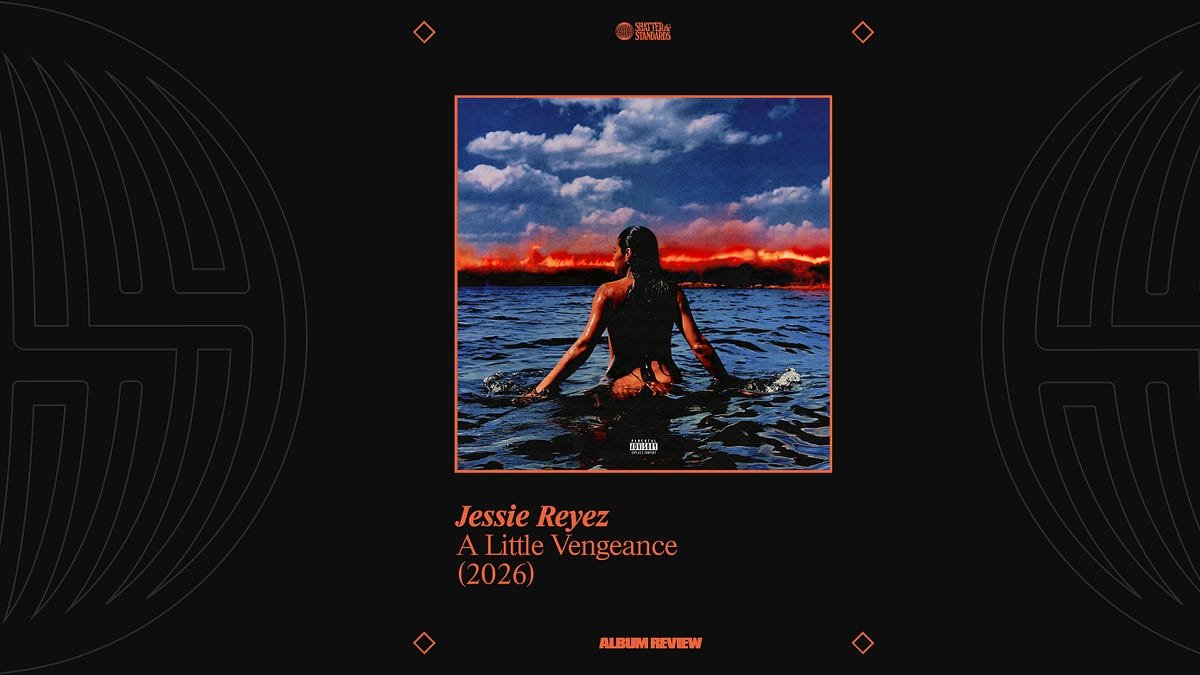
Most breakup albums aim for the dirtiest thing the singer could possibly say, and then say it. Jessie Reyez just keeps going back for the worst and then recoils. On A Little Vengeance, she performs like a person who knows where all the bodies are buried but would rather make sure you know that she’s consciously electing not to exhume them. She sings and speaks, slips into a rap cadence where a statement needs some muscle and across all of it, maintains a mental tally of everything she could do to the man who wronged her and chooses not to do them.
The clearest illustration is “DUSTY,” where she iterates each piece of leverage she holds over the ex and announces, line by line, that she will not use them. “You lucky I don’t hit your wife and tell her that you still reach out,” she sings, then “You lucky I don’t leak those pics that you still got the nerve to send.” The threats are specific, and the mercy conditional. Then she comes through with a definition exercise that determines what kind of man is dusty. “If he asks what you bring to the table, he’s dusty/If he uses the word ‘high value,’ he’s dusty.” On “MADAME JOYCE’S INTERLUDE,” she lets her guard completely down for a story about the one time she didn’t hold back her leverage, going through his phone and changing every suspicious woman’s number by a digit so they’d no longer reach him. “I would say that was art, that was strategy,” she states, quite satisfied. The switched digit lands more impactful than anything subsequent she attempts for peace. By “SALT” the threats held in reserve have a name: she has a fuck you list, and she says she will be petty until she has to have it beaten out of her.
The cadence does most of the work of sorting the emotions. When she is accusing, her cadence will constrict, and the singing will loosen in the throat to something much more conversational. “N.Y.F.F.” is a chant built out of a kiss-off; the hook: a flat four-word dismissal “Don’t call me, I ain’t your fucking friend.” The song’s strongest diss, though, is the one that sounds almost reasonable: “But you’re allergic to the truth/Like the truth just ain’t your shoe size.” By the end, she is already writing him off as a missed call and his women as “Pinocchio them hoes” (contempt added like a garnish). “99%” places this same disgust onto a grid and counts up its grievances: “One, boy, your ass lied too much/Two, all we did was fight and fuck/Three, you don’t believe in therapy.” The melody loosens when the anger does.
When you’re her target, there’s nothing to hold over a wound that you inflicted on someone else. On “EVERYBODY CRIES SOMETIMES,” she states the price on its face and keeps it as plain as possible: “Hollywood paid me, but that bitch cost me a lot,” “My favorite ex has me blocked,” “blessed in this life in every aspect but love.” When there’s no threat to give and no one to humiliate, the language becomes like reporting, almost bland, but that only serves to make it stronger. Pushing that sentiment further back to when she almost went over a balcony on her first trip to LA on “SALT,” then outward to a line that feels like a theory for her own artistry: “Creativity is a curse, it gon’ follow you to the hurse.” On “FUCK YOU JESSIE,” she constructs it as a party where everyone’s fake and her brother isn’t talking to her, her aunt convinced the Illuminati has taken her soul, until her therapist interjects with the one instruction she can’t follow: “Save some of that love you got for yourself.”
It’s in the field of jealousy that she stops holding back. “WHEN YOU HOLD HER” is her most exposed song, focusing on the same question she can’t stop asking of the ex who left: “When you hold her, do you wish that she fit in your arms like I did?” She declares that she was “Never loved enough to be the other woman,” confesses that she deleted all of his photos, and calls herself a “kamikaze passenger.” The bridge makes up for the charade of a clean break: “Every time we say goodbye I know that’s a lie ‘cause I’ll see you later.” Muni Long sings from the other side of it, as the ex who can’t seem to quit her in “AIN’T U TIRED?,” declaring that he can’t “copy paste my love.” Reyez writes the interior of the triangle and Muni Long its corners, and neither gives him a moment’s peace.
Where she starts losing her grip, “SYNESTHESIA” exchanges the breakup narrative for a come-on that’s supposed to cross the senses. The guest artists contribute to the gimmick, D Smoke, for instance, stringing together images that sound pretty, but mean nothing: “You look like rain drops/You taste like symphonies/You sound like butterscotch.” “LOVE & MONEY DON’T GO” offers the opposite problem, stating its concept too obviously to do anything with it beyond the title: “Seems like there’s no time for love/And money, money, money, no love.” Both tracks are listenable, but neither holds the power of the threats, and after a front-half that calls everything out directly, these vague songs feel like a held breath released too early.
God runs under the grievance the whole way. On “CRUMBLE,” she watches a man drop something precious and dubs it “like watching Babylon crumble.” By “N.Y.F.F.” she’s made up her mind that “I see why God didn’t want us to go and eat the fruit,” and on “SALT,” she gives up the debate altogether: “Who am I to argue the design of god?” It’s on “EGO ATROPHY,” the longest, most weary-sounding song on the album, that she runs out of steam and asks god to keep her “close to water, keep me close to God,” resolving that “when I let it all go/I’ll find a way to make my peace.” The song is closed by a spoken sample from a Bob Marley interview about how life is always stronger than death, and life is his only true wealth. It’s the only time someone other than Reyez has the last word on an album about her heartbreak, and she cedes it to a dead man who had lived longer than her and who speaks about staying alive.
The weapons she refuses to brandish against him find her anyway and turn on her. In “iBREAK,” she’s awake at 1 am to his call, then confesses, “I break, I break it all for your love,” and cycles through the arsenal she celebrated in the breakup anthems to find it ultimately useless against her own memory. “UR HEARTBEAT (WHO DO U THINK ABOUT AT 2AM?)” goes all the way: “I don’t wanna move on/Just wanna finally learn your weapons,” then cuts the pretense: “Like it’s platonic, but I want u in my bed.” It turns out the power she held over him, and the scar she has left upon herself, is the same hand. The closest she ever comes to contentment is to whisper to herself, alone in the dark, that she still wants him in her bed.
Great (★★★★☆)
Favorite Track(s): “N.Y.F.F.,” “DUSTY,” “WHEN YOU HOLD HER”
Fonte do Artigo
See more: The Global Track