
Newsletter Subscribe
Enter your email address below and subscribe to our newsletter
Enter your email address below and subscribe to our newsletter


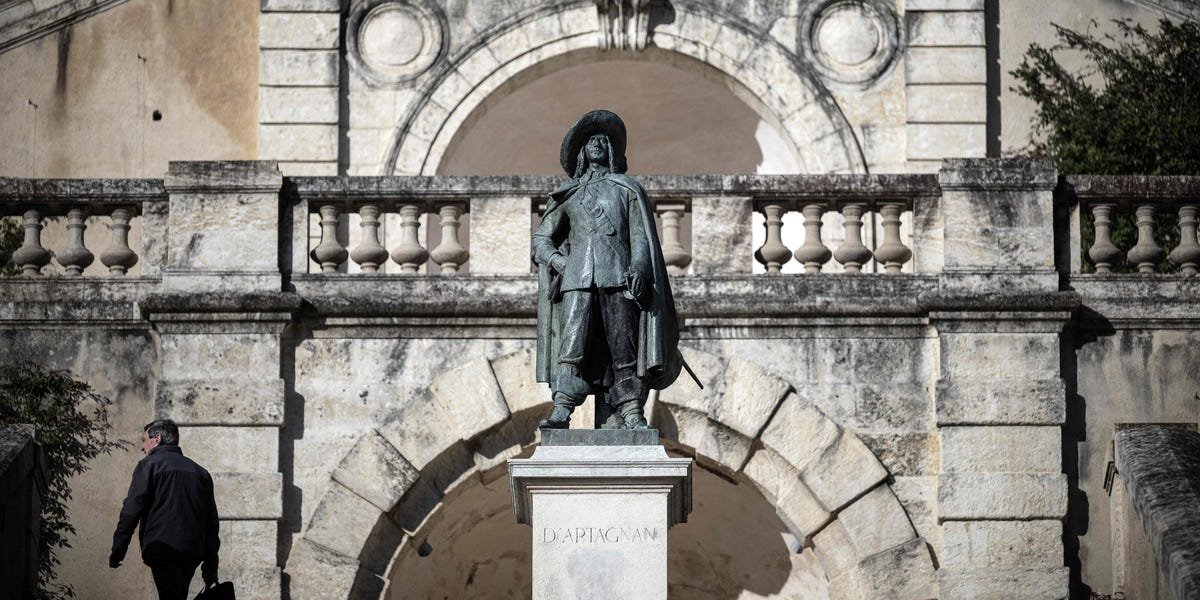
This story is a collaboration with Biography.com.
The fictional character d’Artagnan, the eager young musketeer who opposed the wicked Cardinal Richelieu, originated nearly 200 years ago in the novels of Alexandre Dumas. But d’Artagnan is probably best known for the dozens of screen adaptations of The Three Musketeers he’s starred in since 1903. Plenty of actors have embodied d’Artagnan on the big screen, from silent star Douglas Fairbanks to NCIS star Chris O’Donnell, but long before any of them ever brought Dumas’ swashbuckling character to life, there was a very real d’Artagnan who served as a military commander for King Louis XIV‘s France.
And in a remarkable new discovery, the remains of this flesh and blood d’Artagnan have finally been found. Albeit, obviously, sans his own actual flesh and blood.
Rumors had long persisted that Charles de Batz de Castelmore, better remembered by the moniker Count d’Artagnan, was interred beneath St. Peter and Paul Church in Maastricht, a municipality in the Netherlands, after he was struck down during the Siege of Maastricht in 1673. But since nobody wanted to disturb the floors of the house of worship that allegedly concealed the swashbuckler’s earthly remains, those rumors had never been confirmed—until now, that is.
The only reason for the recent excavation, the church’s Deacon Valke told the BBC, was because “a few tiles had been broken” already, so they figured it wouldn’t hurt to take a peek underneath. When they saw signs of a wall beneath the floor, they called in archeologists and kept digging.

Celebrated silent film swashbuckler Douglas Fairbanks plays d’Artagnan in a 1921 screen adaptation of The Three Musketeers. Actress Mary MacLaren can also be seen here, playing the role of Anne of Austria, another real historical figure featured in Dumas’ novel.
“We became quite silent when we found the first bone,” the Deacon noted. Beneath the floor where the church’s altar had stood for two centuries lay the remains of the man generations of literary fans knew as the comrade of Athos, Porthos, and Aramis (themselves all loosely based on real-life figures as well). Along with the bones, the dig also unearthed a bullet, likely the musket ball that pierced d’Artagnan’s neck and claimed his life in Maastricht. Deacon Valke told the BBC that they also found a coin from 1660 “from the bishop who attended Mass for the Roi Soleil”—the “Sun King” Louis XIV—for whom d’Artagnan was a sort of “right-hand man.”
The archeologist called to the scene, Wim Dijkman, has been researching d’Artagnan’s final resting place for more than two decades. He says that finding d’Artagnan’s grave would be “the highlight of my career,” but he’s not satisfied to settle for the circumstantial evidence of a musket ball and coin. Instead, he’s had a DNA sample extracted from the remains sent to Germany for analysis, while some of the potential musketeer’s bones have been sent nearly 130 miles (208km) north to the town of Deventer “to assess the skeleton’s age, where it is from, and whether it is male or female.”

A 1650 illustration of Charles de Batz-Castelmore, Comte D’Artagnan (c.1611 – 1673), the man Dumas’ d’Artagnan was based on.
If confirmed, this discovery would prove a vital component in the study of the real d’Artagnan, a figure whose life was obscured by fiction mere decades after his death. While he is best remembered now as the heavily fictionalized figure in Dumas’ trilogy The Three Musketeers (1844), Twenty Years After (1845), and The Vicomte of Bragelonne: Ten Years Later (1847-1850), Dumas’ d’Artagnan was originally based on a pseudo-biographical work entitled Les mémoires de M. d’Artagnan, a novel in the form of a biography by Gatien de Courtilz de Sandras published in 1700, 27 years after the real d’Artagnan died.
Gatien de Courtilz de Sandras was known for fabricating events. Enlightenment philosopher Voltaire called it out in his Le Siècle de Louis XIV: “His name is mentioned here […] to warn the French, and especially foreigners, how wary they should be of all these false memoirs printed in Holland. Courtilz was one of the most culpable writers of this kind. He flooded Europe with fictions…” But Dumas saw fit to build his own embellishments upon this fabricated d’Artagnan, and as his stories have endured as literary classics, the facts of real d’Artagnan’s life have faded into the background.
Now, if these bones are confirmed to belong to the Sun King’s steadfast aide, perhaps the true d’Artagnan will once again get his time in the proverbial sun.

Michale Natale is a News Editor for the Hearst Enthusiast Group. As a writer and researcher, he has produced written and audio-visual content for more than fifteen years, spanning historical periods from the dawn of early man to the Golden Age of Hollywood. His stories for the Enthusiast Group have involved coordinating with organizations like the National Parks Service and the Secret Service, and travelling to notable historical sites and archaeological digs, from excavations of America’ earliest colonies to the former homes of Edgar Allan Poe.