Newsletter Subscribe
Enter your email address below and subscribe to our newsletter
Enter your email address below and subscribe to our newsletter


The Athletic has live coverage of the 2026 MLB All-Star Game.
PHILADELPHIA — Dave Roberts arrived at Citizens Bank Park just before 1 p.m. on Monday. He hoped to get a head start on a few things, namely the nearly 100 baseballs he needed to sign. It’s a time-consuming process, he explains, and it can be difficult, if not impossible, to find a time to do it without being interrupted.
Sure enough, eight boxes of balls, stacked neatly on his desk, greet him as he walks into the manager’s office inside the home-side clubhouse.
It’s a spacious and tidy setup, complete with two leather couches and a few extra chairs set up against a wall. But Roberts has no meetings on the docket, no last-minute things to address. Preparing to lead the National League in MLB’s annual All-Star Game is a song-and-dance he and his coaching staff are well-rehearsed in.
As he prepares to manage his fourth All-Star Game, Roberts has agreed to let The Athletic shadow him and his coaches for the day. The entire Los Angeles Dodgers coaching staff, along with guest selections Don Mattingly of the Philadelphia Phillies and Oli Marmol of the St. Louis Cardinals, bustle through the clubhouse halls.
Roberts plops into his chair and grabs a water, a Diet Dr. Pepper and a box of balls. Each player on the NL All-Star team will sign these balls, he explains, and MLB will auction off some of these mementos or use them for various charities. There’s also an autograph etiquette of sorts. The sweet spot is reserved for the manager’s signature. Players know to leave that space open if they sign before their skipper — or at least they should.
But when Roberts grabs a ball out of the box, he sighs.
“Come on, Yamamoto,” Roberts groans, spinning the ball to reveal his ace’s signature, scribbled dangerously close to Roberts’ designated space. “He should know better.”
Roberts’ playful shot at Yoshinobu Yamamoto — one of six Los Angeles Dodgers to make the NL team — is timely. Because he started Saturday, Yamamoto won’t pitch in this year’s Midsummer Classic. In the room next door, pitching coach Mark Prior tries to pin down who will. Prior spent the last week communicating with pitching coaches around the league, analyzing workloads and availability and learning about any issues or concerns teams have about their star pitchers participating in this storied exhibition game.
Prior walks into Roberts’ office with a detailed sheet showing all of the National League’s available pitchers. He’s just heard from the San Diego Padres and Washington Nationals with updates on Mason Miller and Foster Griffin, both of whom will be able to pitch, albeit with some limitations. But usage restrictions for starters on two other teams leave them with nine arms for nine innings, Prior says. Rarely does a pitcher in the All-Star Game record more than two innings, and Prior wants to ensure they don’t run out of arms.
But before Prior and Roberts can finish the conversation, a member of the Dodgers’ public relations staff arrives to whisk the latter away to media duties. Roberts and John Schneider, the manager of the Toronto Blue Jays and the American League All-Stars, are due for a news conference with their selected starting pitchers. Prior retreats to the coaches room, where he and assistant pitching coach Connor McGuiness continue to map out the usage.
The baseballs will have to wait.
Dave Roberts was all smiles signing All-Star baseballs, at least until he saw that one of his pitchers took his sweet spot. (Katie Woo / The Athletic)
It helps that Roberts has already made his most pressing pregame decisions. His starting lineup is set, with Philadelphia’s Cristopher Sanchez getting the nod as the starting pitcher.
“I try to do it from the lens of: This is for the fans,” Roberts explained from his desk chair. “What allows for the fans to have the best experience? Their hometown guy starting the game is the way to do it.”
He finalized his lineup with bench coach Danny Lehmann on the plane Sunday night. It’s helpful that the starting nine was decided by a fan vote weeks ago. But Roberts and Lehmann still had to decide on the batting order, something complicated by the seven left-handed hitters selected.
“Obviously the starters were voted in,” Roberts said. “But construction-wise, some of it is performance and body of work, and there is some game strategy there. We have a ton of left-handed hitters. So how can I break up the lefties? I can use Andy Pages, or Ozzie Albies, who is better versus left-handed pitching, for example.”
But Roberts also believes in rewarding strong performances and stellar careers.
“Ozzie, this is his fourth All-Star Game, so I wanted him to hit up higher than guys in their first game,” he said. “I want them to pay their dues. CJ Abrams, he’s in his second All-Star Game, but he’s had such a huge year.”
Ultimately, Roberts and Lehmann decided on five straight lefties to lead off the order: Kyle Schwarber, Juan Soto, Freeman, Abrams and Muncy. He thought about hitting Muncy cleanup, but checked himself.
“I wanted to break up a little bit of my Dodgers bias,” he laughed.
By the time he arrived at the field Monday, he had just one position quandary to clear up. Both Soto and Brandon Marsh play left field. Roberts deferred to Soto’s seniority and asked him where he’d rather play. He wanted left, which shifted Marsh to right.
Making the starting lineup, all things considered, is fairly easy. It’s figuring out how many at-bats the starters want, mapping out the substitutions and ensuring the best possible chance of every player getting an opportunity to play that gets complicated.
“The tough part is filtering the next guys,” Lehmann said. “Some of it is service time, some of it’s the number of All-Star appearances they’ve had, and some of it is where they’re at in their careers. Like with this game, it’s both good and bad that there are so many Phillies here. With Schwarber, (Bryce) Harper and Marsh, trying to get them in their home stadium and giving them as much playing time, but at the same time respecting others and not having to wait until the ninth to rush them in.
“But it starts with the starting lineup and what they want, because they earned that. Most guys want one or two (at-bats). But we have 21 position players, so it’s not a straight sub, nine-for-nine deal. Trying to figure out which of those guys only want one at-bat makes it a lot easier to get those extra three in there.”
Configuring the pitching side remains a work in progress for Prior. Most teams have disclosed their pitcher availability by now, but McGuiness laughs when he recalls the year where an organization waited until a few hours before the first pitch.
The silver lining, he says, is that he and Prior can worry a little less about playing the matchups, since there will be so many substitutions.
“In a perfect world, it’d be awesome to lane guys up, but they’re going to be pinch hitting on the other side just as much as us,” McGuiness said. “So a lot of this is more figuring out where guys are comfortable coming into the game.”

Dave Roberts talks with Corbin Carroll of the Arizona Diamondbacks and James Wood of the Washington Nationals during the NL team’s workout. (Daniel Shirey / MLB Photos via Getty Images)
There’s always an emphasis on deploying the starting pitchers first. Prior and McGuiness are still contemplating who will follow Sánchez. They could stack the fan favorites and throw Jesús Luzardo next. But 33-year-old Eduardo Rodriguez was named an All-Star for the first time in his 11-year career, and they’d like to honor that, too.
They do know how they’d like to close the game in a potential save situation. When choosing between Miller or Jhoan Duran for closing duties, they again opted in favor of the home crowd. Miller, making his second All-Star Game, understood.
“I was expecting him for the ninth,” Miller said to McGuiness. “It doesn’t bother me at all.”
All that’s left is the middle innings. Prior and McGuiness know better than to believe a baseball game can be scripted. They need a break-glass-in-case-of-emergency guy, someone who has experience starting and relieving, can pitch multiple innings and can get ready quickly. Conveniently, McGuiness knows just the guy.
“We think (Justin) Wrobleski can be our flexibility,” he said, referring to the Dodgers’ budding starting pitcher. “He’s kind of the perfect guy for this.”
Dino Ebel stomps down the dugout steps, out of the beaming sun and into the air-conditioned reprieve of the clubhouse tunnel. He ducks into a storage room and plops onto a stool, sweating but smiling. It is nearing 4:30 p.m.
Ebel, the Dodgers’ third-base coach, is in charge of the usual scouting and video prep needed to game plan against the American League. He has also been tasked with communicating with the outfield reserves and ensuring each sub knows when their name is likely to be called.
“Communication is big in the All-Star Game,” Ebel said. “These guys want to know when they’re coming in, coming out. So I have to make sure guys are prepared to pinch run, sub in.”
But Ebel’s most pressing duty of the day will be unrelated to game preparation. He’s participating in the Home Run Derby, pitching to local legend Bryce Harper. Ebel and Harper, along with the seven other participants and their selected batting-practice pitchers, are fresh out of a meeting with MLB, where the new format was explained once more. Soon, batting practice will start. Ebel will coordinate whether Harper will want to hit on the field or in the cage. The two will then do one more session on the field shortly before the Derby begins.
Ebel is a seasoned pro. Monday night will be the fifth time he’s thrown batting practice at the Home Run Derby. He threw to Teoscar Hernández when Hernández won in 2024, and pitched in last year’s All-Star Game-deciding swing-off, which the NL won.
“I never take anything for granted,” Ebel said. “I became a coach to throw good BP to players because I know what it does to players. To get asked by another team that’s participating, that means a lot.”
But he still has time to join the rest of the Dodgers coaches on the field during the National League’s on-field window. He hits groundballs to those who want it. Prior and McGuiness, along with bullpen coach Josh Bard, bop around to different pitchers, seeing who wants to throw or if anyone needs a catch partner. Hitting coaches Aaron Bates and Robert Van Scoyoc lean behind the batting shell as their hitters take batting practice. Jordan Walker of the St. Louis Cardinals launches one over the fence — foreshadowing an epic Home Run Derby.
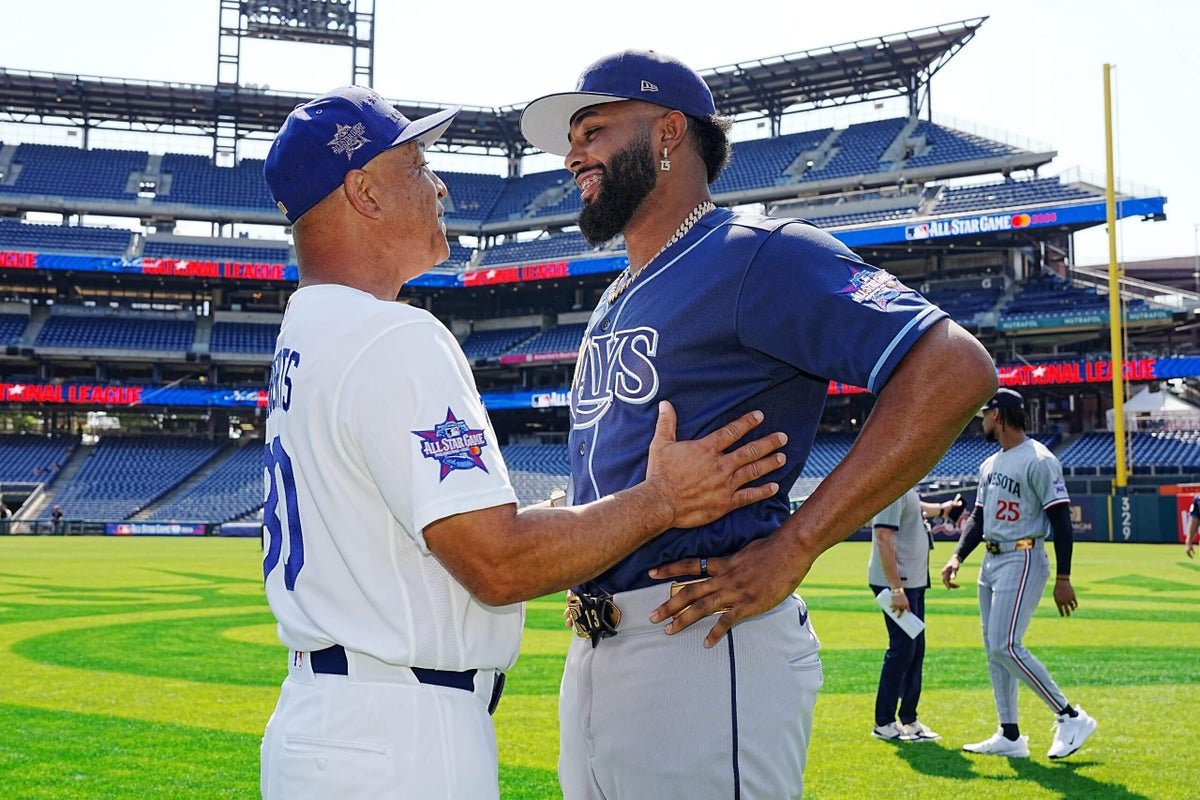
Meanwhile, Roberts is back on the media train. After television interviews with MLB Network and Fox, he mingles with reporters on the field and catches up with players — current and retired. As an ambassador of the game, Roberts knows the importance of celebrating this special week.
“There is a lot of work that goes into this, as far as interviews,” Roberts said. “Every fan base wants their moment with their players. But it’s also fun. The best thing is all the players that get to spend time with one another. That’s the coolest thing. When you peek back and guys are joking with each other in the cage, start talking about their approach. That really is a lot of fun.”
Soon after, though, Roberts sneaks away from the masses and ducks back to his office. He will stay to watch the Derby and finalize any last-minute lineup changes. It’s nearing 6 p.m., and he has one thing left on his to-do list.
There are still baseballs that need to be signed.
Source link
See more: The Global Track