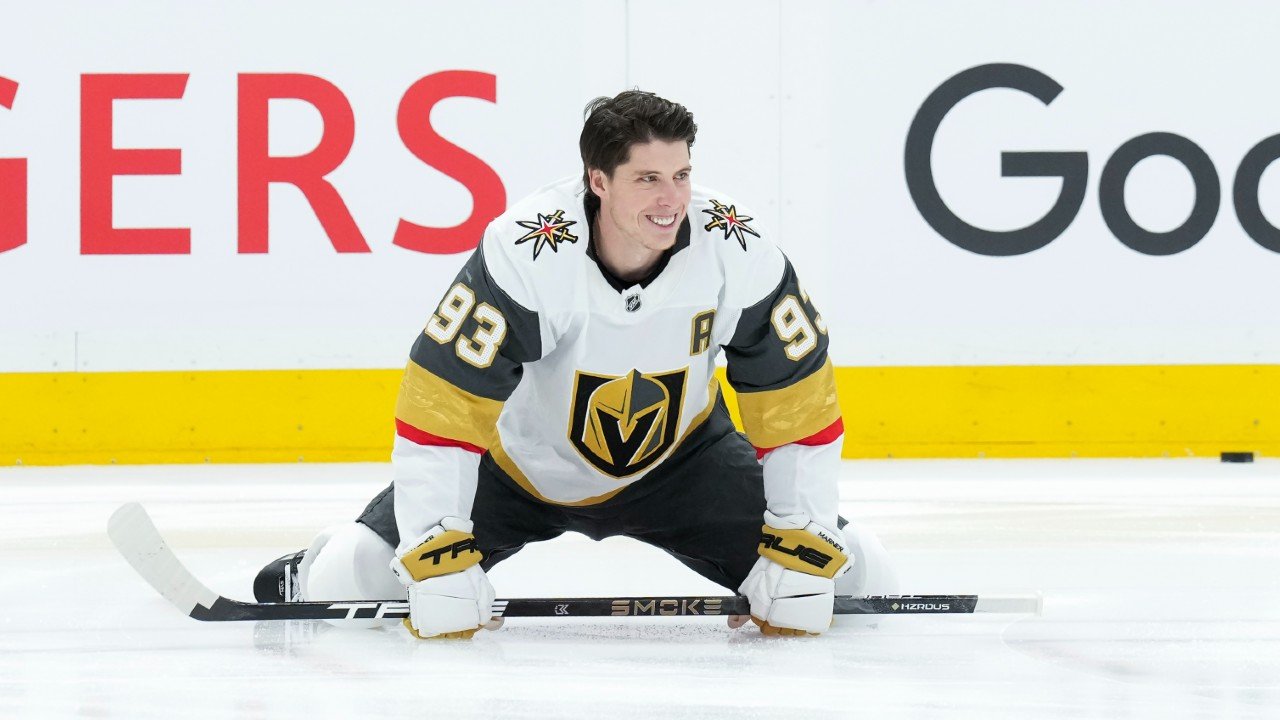
Marner enjoying ‘marvelous playoffs’ with Golden Knights, Ferraro says

Marner enjoying 'marvelous playoffs' with Golden Knights, Ferraro says

The Golden Knights (39-26-17) finished first in the Pacific Division and made a coaching change with eight games remaining, replacing Bruce Cassidy with John Tortorella on March 29. They eliminated the Utah Mammoth and Anaheim Ducks from the Western Conference First and Second Round, each in six games, and swept the Colorado Avalanche in the Western Conference Final. They’re 20-5-1, including the playoffs, since Tortorella took over.

“When ‘Torts’ came in, there were eight games left and they virtually won out when he was there,” Ferraro said. “All of sudden they hit the playoffs and they feel different, although they really don’t look different except for (goalie) Carter Hart.

“I think Torts’ approach was fresh enough to give them a little bit of a jump start.”

Marner is playing right wing on the Golden Knights’ second line with Karlsson at center and Brett Howden at left wing. He’s benefited with Karlsson’s return from a lower-body injury sustained Nov. 8, which limited him to 14 games this season.

Karlsson has six points (two goals, four assists) in 12 playoff games.

“If Mitch Marner only had 80 points in Toronto this year, it would have been a really disappointing year, that would have been the narrative,” Ferraro said. “He had 80 points in Vegas and it’s just fine. He had a good year, he played center for a lot of the year and Karlsson comes back, and he goes to the wing, and he just has to be one of the guys.”

Vegas has 12 players on its roster who have won the Stanley Cup: defensemen Brayden McNabb, Ben Hutton and Shea Theodore; forwards Jack Eichel, Reilly Smith, Howden, Karlsson, Brandon Saad (twice), Ivan Barbashev (twice), Keegan Kolesar and Mark Stone; and goalie Adin Hill.

“In Game 1, it was Eichel’s line,” Ferraro said. “One game it’s Karlsson’s line, one game it’s (Colton) Sissons’ line. It just rolls over. I think the build of the team allows Marner to just do his thing and he’s done it exceptionally well.”

Source link
More: The Global Track

Corinthia Mes

Karlsson, Marner, Howden Line Has Changed VGK’s Outlook

Karlsson, Marner, Howden Line Has Changed VGK's Outlook

(Photo Credit: @GoldenKnights on X/Twitter)

William Karlsson’s return to the lineup has made a massive impact in the look and feel of the Golden Knights’ top six. It took him a few games to get there and to find the correct wingers to have that impact, though.

When Karlsson first returned from the injury that sidelined him for nearly six months, he was slotted in with Tomas Hertl and Keegan Kolesar for Games 1 and 2 against the Anaheim Ducks in the Second Round. And while Vegas won one of those games, it wasn’t necessarily pretty, and it led to head coach John Tortorella mixing things up as the games went on.

It was late in Game 2 that he found a combination that seemed to click almost instantly. In the 3rd period, with VGK trailing by two goals, Karlsson was swapped onto a line with Mitch Marner and Mark Stone. They quickly started to generate chances and looked like Vegas’ most dangerous line in a game they struggled to create much as a team.

When Bill (William Karlsson) came back, we tried it, and yeah, I don’t know. Coaches just try different things and if something sticks, it’s usually two guys that can play well with one another. That one kind of had some glue to it right away. -John Tortorella

Tortorella stuck with Karlsson and Marner together for the third game of that series, opting to use Brett Howden on the left wing. It has stuck since as they’ve played every one of the last five games together, turning into one of the best lines still going in the postseason.

Just have confidence with whoever you’re out there with. My big thing is always just trying to talk and make sure people know where I am, and I want to know where they are as well to try to make those plays. So, I think we’ve done a really good job of that. We’ve got to continue to do it because it’s just going to get harder. -Mitch Marner

The trio played more than 10 minutes together in Game 1 of the Western Conference Final and routinely looked dangerous in the offensive zone. Plus, they were used in offensive and defensive situations, as well as against Colorado’s 1st, 2nd, and 3rd lines.

It’s an important line for me because I can use them not just in offensive situations, but on both circles in our end. Yeah, it’s a very important line, especially with Stone being out. -John Tororella

Both Karlsson and Marner logged more than 21 minutes in Game 1, and Howden clocked in with 18:11, his largest minute load in a game that ended in regulation this postseason, and just four seconds off his highest TOI in a game during the regular season.

VGK’s “second” line is a coach’s dream and an opponent’s nightmare. It’s made up of three bona fide centermen, has faceoff options on both sides of the ice, has two players who have received Selke votes in their career, and currently boasts the #2 and #3 leading goal scorers in the 2026 playoffs. It has changed the way Tortorella can utilize his forward lines, and it’s created matchup problems for a pair of Stanley Cup-winning coaches.

It’s also a massive reason why the Golden Knights are seven wins away from hoisting the Stanley Cup.

Source link
More: https://theglobaltrack.com/
https://corinthiames.com.br/

Mitch Marner in the NHL playoffs: The many truths (and myths)

Mitch Marner in the NHL playoffs: The many truths (and myths)

This felt inevitable, didn’t it?

That Mitch Marner, the Golden Knight, would morph into a playoff-conquering superstar.

But what happens in Vegas really does stay in Vegas.

Marner’s performance this spring doesn’t change all that came before it in Toronto.

There are many truths (and myths) to the Marner postseason experience.


Marner never did this for the better part of nine postseasons as a Leaf.

Never performed like the best player on the ice repeatedly throughout a playoff series, never looked (and acted) like the rare and unique superstar he was during the regular season, the one who could shred foes on both ends of the ice.

The only real outlier was the 2018 playoffs when Marner, still just 20 and only in his second NHL season, dazzled the Boston Bruins with nine points in a seven-game first-round loss.

It all changed after that.

The tension grew and grew and grew with every series the Leafs didn’t win and that Marner didn’t perform like the star his team needed him (and paid him) to be, especially in the biggest moments.

He wasn’t alone, certainly.

His three fellow co-stars, Auston Matthews, William Nylander and John Tavares, also struggled to make their mark, some less so than Marner. But it was Marner who took the most blame, largely due to the controversial six-year contract extension he signed with the Leafs in the fall of 2019. His perception in the market forever changed after that, bubbling up again into fury with every postseason failure.

But it was something else too: More than Matthews, Nylander and Tavares, Marner just looked different in the playoffs.

The joy and freedom he exuded in racking up the sixth-most regular-season points in Leafs history disappeared, and in their place came a tighter, tenser version of Marner. One who was visibly burdened by the mounting pressure and scrutiny. One who was too stressed to hold the puck and make plays when the Leafs needed him to.

He put up points, sure, but the impact was duller than it needed to be.

Marner’s tenure with the Leafs was clouded by playoff disappointment. (Claus Andersen / Getty Images)

What’s stood out most about Marner’s run with Vegas this spring is just how free and in control he looks, with the results to match.

Marner entered his first conference final appearance in the NHL with more goals (seven) and points (18) than he ever had in any one of his nine postseasons with the Leafs.

He had five multi-point games in those first two rounds (12 games), one more than he had in his last four rounds (25 games) as a Leaf.

The playmaking has been spectacular at times, as it often is with Marner, but it’s the scoring that really pops offensively.

Marner once went 18 games — over the span of three postseasons — without scoring even once for the Leafs. He went his first 40 playoff games as a Leaf, for that matter, without scoring a single power-play goal.

Marner finally ended that drought in the 2023 playoffs with what proved to be his only power-play goal for the Leafs in the postseason. He already has two power-play goals for the Golden Knights in these playoffs.

His seven goals overall are one shy of the eight he had in his last 56 playoff games as a Leaf.

Hot shooting is part of the story, but so is a newfound level of calmness, coolness and confidence from Marner shooting pucks in big spots, most notably on the breakaway goal he scored in the first minute of a Game 6 closeout win over the Anaheim Ducks.

Marner never had a moment close to this as a Leaf, a moment of that magnitude when all the tools in his incredible toolbox shone through:

Nor did he have a game like that when the Leafs really needed it. (Marner added his second point in that second-round clincher on Vegas’ second goal of the night with a brilliant setup of Brett Howden’s short-handed marker.) Again, he was far from alone. But we’re talking about Marner here, and while the depth of his playoff struggles may have been overstated at times, the core premise wasn’t unearned.

The Leafs needed a lot more from him in the postseason. They needed what the Golden Knights are getting now.

Things are different for him in Vegas for a whole bunch of reasons.

The stakes for one thing. Marner is no longer trying to end decades of championship futility, at home, for the team he grew up rooting for. That burden is gone. And so is the scrutiny and pressure that came with it — and with being a Leaf, period.

There was no referendum on Marner when the Golden Knights went down 2-1 in their first-round series against Utah, like there would have been under similar circumstances in Toronto.

That was part of the appeal, it seemed, in his decision to join Vegas on an eight-year contract last summer.

Marner was also hopping aboard a team with snarl, a winning history and a roster full of proven playoff contributors. He didn’t have to be the guy for the Golden Knights, just one of many.

Marner joined a deep Vegas team with a winning history. (Rob Gray / Imagn Images)

And while Marner deserves only credit for crushing the Mammoth and Ducks, those two young and largely inexperienced opponents pale in comparison to the kind of squads he faced, and struggled to break through against, perennially with the Leafs — the Tampa Bay Lightning, Florida Panthers and Bruins most famously.

The Presidents’ Trophy-winning Colorado Avalanche will pose a much tougher test.

Truth is, Marner wouldn’t be playing for the Golden Knights right now if he had done this in the playoffs for the Leafs.

He would, almost certainly, still be a Leaf — and probably the most popular Leaf for that matter

In that alternate version of history, the Leafs almost certainly go on at least one deep playoff run. Maybe they reach the Eastern Conference final. Maybe they lose in the Stanley Cup Final. Maybe they actually win the franchise’s first Cup since 1967.

Marner would have been a hero in that world and would have had no reason to leave his team and city. And the complexion of the Leafs would be entirely different because of it.

If a breakthrough happened earlier than later, the Leafs probably wouldn’t let Kyle Dubas get away as general manager. Brendan Shanahan surely reaps the rewards for forever believing in Marner and the Core Four and continues as team president into the present. Sheldon Keefe might still be the Leafs coach.

It’s possible that all the recent chaos would never have happened. There may be no Brad Treliving, no Craig Berube, no John Chayka running the team with Mats Sundin. There would be no threat of Matthews leaving with two years still left on his contract.

But alas, that’s not what happened. Instead, it was Marner’s performance in the playoffs that spurred the criticism that led him to go elsewhere.

Would the breakthrough have come in Toronto had he stuck around last summer? After nine tries of mounting disappointment, it seems unlikely. Leaving was (likely) the only way this was going to happen for Marner.

He had to get away from Toronto, get away from being a Leaf, to reach his potential.

Marner is at a different point in his life now, too. He turned 29 earlier this month, he’s a father, an Olympian and the resident of a quiet community in Nevada. And he has all those playoff scars from his time with the Leafs.

His legacy will continue to evolve. It might eventually include the Stanley Cup, and even a Conn Smythe Trophy, if the Golden Knights can somehow upend the Avs in the Western Conference final.

What happened in Toronto still happened, though. What happens in Vegas stays in Vegas.

Source link
See more: https://theglobaltrack.com/
https://corinthiames.com.br/

Vegas Golden Knights find success with William Karlsson, Mitch Marner, Brett Howden line | Golden Knights

Golden Knights right wing Mitch Marner (93) celebrates his goal against the Anaheim Ducks durin ...

One of the best compliments NHL players can get is that they can play with anybody.

Ask around the Vegas Golden Knights’ locker room and William Karlsson gets that label placed on him more than anyone. It’s been that way for nine years.

That’s why it wasn’t a surprise to see Karlsson, after missing six months with a lower-body injury, jump back into the lineup in the second round against the Anaheim Ducks and make an immediate impact.

Which is why it wasn’t shocking that the Knights’ best line in the series was Karlsson centering Brett Howden and Mitch Marner through four-plus games. And it’s a line that could be a difference maker in the Western Conference Final against the Colorado Avalanche.

Karlsson missed 68 games in the regular season and all of the first round against Utah. He hadn’t skated once with Marner this year. He played with Howden twice.

“I knew a little but about Will throughout coming here,” Marner said. “I didn’t know as much as people were telling me about him. It was big for us at the start of the season, and losing him was a big hit for our team, as well.”

Putting the pieces together

The one benefit coach John Tortorella had with Karlsson coming back is he had options. He tried Karlsson with Tomas Hertl and Keegan Kolesar the first five periods. That didn’t work.

In the third period of Game 2, Tortorella moved Karlsson with Howden and Marner. It elevated Karlsson back to a top-six role. It also moved Marner back to his traditional right-wing spot.

It freed up Marner to return more to that playmaking role while also easing up the burden of being the responsible man down the middle.

The line’s first act together was a good one. Marner recorded his first career playoff hat trick in Game 3.

Karlsson isn’t a puck-dominant center. He knows when to get his teammates the puck and get out of the way. When you have a linemate like Marner, it’s easier to do that.

“He’s very vocal out there, so he makes it easy for you,” Karlsson said. “I always know where he is, so that’s a great part of his game. A great player, and easy to play with.”

Marner had nine of his 11 points in the series in Games 3-6. Howden had three goals and an assist. Karlsson had three assists.

The Knights want to play with speed and aggression. Sometimes, that’s good. Other times, it can be catastrophic.

The mindset changes with three responsible skaters that can turn defense into offense. Karlsson and Marner are two of the best 200-foot players in the league. Howden had to become sound defensively to carve out his role as an offensive threat.

“It’s been really easy to play with him. He makes a lot of great plays. He seems like he’s always in a great spot defensively with his stick and his feet,” Marner said. “He makes it easy on our (defensemen) to break out pucks.”

Reading off each other

That mindset leads to moments like Marner’s highlight-reel goal in the opening minutes of Game 6 on Thursday in Anaheim.

Howden chipped the puck to the corner for Shea Theodore to start a quick breakout. Karlsson took the puck and saw Marner streaking down the middle.

Marner took the risk knowing there’s plenty of open ice, and knowing he had Ducks defenseman Jackson LaCombe draped over him. Marner made a slight hesitation at center ice to create separation for Karlsson to put the puck on his stick.

Marner, of course, did the rest for what’s been the goal of the playoffs to this point.

“I was just trying to read the play,” Marner said. “As soon as I saw it go to Shea’s stick, I thought he could hit Karl, which he did. From there, I just tried to find open ice and cut through the middle. Karl made a great pass to me.”

Howden’s goal in Game 4 was another example. Karlsson, moments after hopping over the boards, took the wall pass from Marner and chipped it to the corner. Karlsson won the race, took a hit from Anaheim’s Jacob Trouba and found Howden in front.

Building the trust

It’s helped that Marner and Howden have chemistry as the playoffs have rolled on. Howden has three of the Knights’ four short-handed goals of the playoffs. Marner has had the primary assist on all of them.

Each time, it has been Howden finding the soft spot in the defense after Marner made the play. Game 6 was no different with Howden drawing attention from both Anaheim defensemen, leaving Howden alone on the weak side.

“As soon as I see him have the puck, I seen that he had time and space. I just tried building up some speed,” Howden said. “I thought he was going to kick it out to me, and he didn’t. When he has the puck on his stick, I just try to get to the net and find some space.”

It’s not like the analytics were dominant. The three were outshot 25-17 while on the ice and shot attempts were 46-36 in favor of the Ducks.

But the Knights had a 2-0 edge in goals, an 11-9 advantage in high-danger chances and 20-16 in scoring chances, according to Natural Stat Trick. They did their job in the areas that mattered.

If the Knights have an advantage that Colorado didn’t see its first two rounds, it’s a line that can control play at both ends of the ice.

“It’s just been clicking so far, but we’ve got to keep going,” Karlsson said.

Contact Danny Webster at dwebster@reviewjournal.com. Follow @DannyWebster21 on X.

Up next

Who: Golden Knights at Avalanche

What: Western Conference Final, Game 1

When: 5 p.m. Wednesday

Where: Ball Arena, Denver

TV: ESPN

Radio: KFLG 94.7 FM/KKGK 1340 AM

Line: Avalanche -185; total 6

Source link
More: https://theglobaltrack.com/
https://corinthiames.com.br/

How Maple Leafs’ divorce with Mitch Marner has worked out for both parties (so far)

How Maple Leafs’ divorce with Mitch Marner has worked out for both parties (so far)

How Maple Leafs’ divorce with Mitch Marner has worked out for both parties (so far)

Aside from the obvious missing the playoffs and threatening to give the Boston Bruins their first-round pick, the final four in the NHL currently consists of the rival Montreal Canadiens, former Leaf Frederik Andersen’s Carolina Hurricanes, former Leaf Nazem Kadri’s Colorado Avalanche, and former Leaf Mitch Marner’s Vegas Golden Knights (everybody should be cheering for Kadri, by the way!)
The perfect cherry on top to this disaster of a season would have been the Bruins getting a top-10 pick and adding another top prospect to their system after already taking Fraser Minten. But, luck bounced the other way on draft lottery night, and out of nowhere, the Leafs are primed to select Marner’s replacement first overall in the upcoming draft and essentially give themselves an assignment extension in doing so.

The Maple Leafs’ breakup with Marner was a necessary one. As much as the hockey world is having a field day with Marner currently leading the NHL in playoff scoring, with seven goals and 18 points in 12 games, it’s worth an evergreen reminder that what we’re seeing from Marner right now never would have happened in Toronto. With the contrast in spotlight between the two markets, the fact that Vegas won a Cup three years ago and doesn’t have the historical pressure of the Maple Leafs, and the fact that he has so far faced two first-time playoff teams in their current forms, it’s no surprise that Marner is thriving in Vegas.

At the same time, it would be naive to pretend that Marner’s departure had absolutely zero impact on their fortunes this season. They may have only been a wildcard team had he stuck around, but they certainly wouldn’t have missed the playoffs to the degree that they did. It’s hard to replace a 90-plus point forward with Selke-level defensive capabilities, playoff success be damned, and it became obvious right away that Nicolas Roy, Dakota Joshua, and Matias Maccelli weren’t enough to do so.

Had the Leafs not retained their first round pick this year, and even if they did so at fifth overall, this likely isn’t an article that’s being written right now. But adding Gavin McKenna, a premier game-breaking winger who showcased his talents at Penn State and for Canada at the World Juniors, to a team that visibly struggled without a star winger riding shotgun with Auston Matthews, is a game changer. Sure, McKenna might be behind the rest of the core age-wise, but he’s got the talent to find chemistry with players like Matthews quickly, especially if they hire a coach who prioritizes puck possession and creativity.

It also stops the Leafs from having to spread their wealth evenly in free agency and will allow them to focus heavy on revamping the defensive corps with NHL-ready help and perhaps pivot back for a second-line centre without having to accept Max Domi as one of their top-line wingers in exchange for that. With two years remaining before Matthews hits free agency, the luck of drawing the first overall will extend their competitive window rather than having to ask tough questions about accepting defeat on this era and spending the next five years at the bottom of the standings.

Oh, and while this is all happening, Marner gets to put on a show in the playoffs in a much more positive light than the one he was viewed in while he was a Leaf. He even gets to score in a Game 7 and make it look like his former team was entirely to blame for his lack of success in Toronto.

Now that we’ve made all of those points known, you can see that there’s a legitimate argument to be made here that the divorce, as of right now, is benefitting both sides. Is the jury still out on Marner in the playoffs given that both teams he’s faced so far finished with seven fewer points than the Ottawa Senators did last year? Yes. Did the Leafs completely stumble into their part of this, and is it entirely possible that they screw things up with the first overall pick and plummet into mediocrity under John Chayka’s watch? Absolutely. But where we stand right now, on the morning of the Western Conference Final with the Maple Leafs a month away from adding a young franchise piece, the grass is looking green as ever for both parties.

Sponsored by bet365

Source link
See more: https://theglobaltrack.com/
https://corinthiames.com.br/

Golden Knights’ Tortorella calls out Marner critics

Golden Knights' Tortorella calls out Marner critics


It was classic John Tortorella.

Asked about the play of Mitch Marner in the aftermath of his hat trick in Game 3 on Friday night against the Anaheim Ducks, the fiery Vegas Golden Knights coach decided to take the question in a unique direction.

“You guys don’t see the stuff he does,” Tortorella told reporters Saturday. “People here, people in Toronto, all the people that talk about this guy, they don’t see any of the things that he brings to a game even if he doesn’t score a goal. I’ve known that coaching against him.

“That narrative (that Marner struggles in the playoffs) is a bunch of (expletive). Like I said last night, Mitch doesn’t care. Mitch is a pro. He’s a terrific player, one of the top players in this league and he plays for us.”

Marner, of course, received a good deal of criticism in Toronto for being a key player on a Leafs team that didn’t get past the second round the past nine years.

Marner leads the NHL with 13 points (six goals and seven assists) in nine playoff games in his first season with Vegas.

The native of Thornhill, Ont., had 63 points in 70 career playoff games for Toronto.

The Golden Knights lead the Ducks 2-1 in their second-round series. Watch Game 4 on Sunday at 9:30 p.m. ET / 6:30 p.m. PT on Sportsnet or Sportsnet+.


Source link

Mitch Marner set for first NHL playoffs with Vegas Golden Knights | Golden Knights

Vegas Golden Knights right wing Mitch Marner (93) reacts after shot is stopped against the Wash ...

You’re guaranteed, at least twice every practice, to hear Mitch Marner make his presence felt.

It could be the occasional jab at one of his fellow skaters. It could be a noticeable yell each time he scores on one of the goalies, making sure they hear him loud and clear.

Marner made it clear from his first ever with the Vegas Golden Knights back in September. He was going to chirp. He was going to be loud on occasion.

Outside of that, it was a quiet season for Marner. He’s mostly reserved, maybe still keeping his guard up in the locker room after years of Toronto-based microphones and cameras in his face.

Marner finished with 80 points — a team-high 22 of them coming after the Olympic break — while spending the second half of the year playing center for the first extended time of his NHL career.

“It’s always a challenge to get to the playoffs,” Marner said. “You make it in, and then the real work begins. I’m just excited to get in there with this group.”

The moment Marner put pen to paper on that eight-year, $96 million contract to make him the richest free agent acquisition in franchise history, September to April wasn’t going to matter.

He’s been a 100-point scorer. He’s hit the 80-point mark six times as of this season. Only Connor McDavid has put up more points than Marner’s 821 in his 738-game career among the 2015 draft class. He’s been among the league’s elite in the regular season.

Changing the narrative

But the playoffs are here. And with that comes the label that followed Marner’s near-entire tenure in Toronto, and one he looks to shake in his first postseason with the Knights.

In 70 career playoff games, Marner has 13 goals and 63 points. Four times in the playoffs has he been a point-per-game player. He’s never advanced beyond the second round, and he made it that far twice with the Maple Leafs.

Then there’s the claim that Marner hasn’t performed when a series is at its apex. In Games 5-7 of a playoff series from 2019-25, Marner has no goals and seven assists.

Marner got the brunt of the blame for Toronto’s shortcomings, largely because he was the hometown kid. The story wrote itself, that the Ontario native would find a way to lead the Maple Leafs to glory.

Auston Matthews didn’t get that much heat. Nor did William Nylander or Morgan Rielly, the other members of Toronto’s infamous Core Four.

The criticism from media and fans followed Marner until his last playoff game with Toronto — a 6-1 defeat on home ice in Game 7 to the eventual champion Florida Panthers. He had two shots in 18:43 and was a minus-2.

“You just can’t care about it,” Marner said. “Everyone has their own opinions. They want to say what they want to say. Nothing you can do about it. You just got to focus on yourself and what you can do.”

Marner, as simple as he could answer it, said the easiest way to handle the criticism was to avoid social media, reading the news, or reading anything that anyone had to say.

It’s his way of trying to stay locked in. That’s how he’s approaching this postseason.

“I’m just trying not to read into it,” Marner said. “I’m just trying to focus on what I can do on the ice.”

A season of changes

There’s no sense in trying to convince one side of the aisle over the other on whether Marner deserved the blame for Toronto’s shortcomings.

One thing is certain: He can’t be blamed this year for the Maple Leafs missing the playoffs, while the Knights are one of 16 teams left playing for a Stanley Cup.

This season was anything but conventional for Marner. Injuries pushed him to full-time center for a large portion of the season, outside of his usual right wing spot.

Outside of the faceoff aspect, Marner’s defensive prowess allowed him to be a serviceable fit down the middle.

His scoring took a considerable dip from the 102 he had last year, finishing fewer than a point per game for the first time since 2017-18.

“It’s different when you look at only the points, which some people do,” general manager Kelly McCrimmon said. “It’s not all points. There’s just so many things in the game over the course of the night that are so special in terms of what he does with his hockey sense and skill.”

Does he feel Marner is motivated to silence his playoff critics?

“I think some of that stuff matters more to the critics than it does to people,” McCrimmon said. “You worry about winning. You just really put your attention to that.

“Is Mitch Marner excited about the Stanley Cup Playoffs? I’m sure he’s excited as hell. All of our players are. It’s that time of year.”

Playoff performer?

Postseason narrative be damned, that’s why Marner was brought to Las Vegas.

McCrimmon felt they needed a dynamic winger to complement center Jack Eichel and captain Mark Stone. Coach John Tortorella put those three together in the first practice prior to Sunday’s Game 1 against the Utah Mammoth.

It’s unclear how long those three play together, but Tortorella isn’t afraid to line up his three best forwards to set the tone.

“Mitch is a great hockey player,” Tortorella said. “He’s a complete player. Very important guy. One of the top players in our league. He does a lot of things for us.”

It took Marner some time to get acclimated to his new home. There’s still a part of him that may feel he’s still adjusting to life outside of Toronto. The quiet has helped.

How loud the volume gets may only be determined with how he does in the postseason.

“It’s not going to be easy,” Marner said. “There’s going to be lots of ups and downs.

“We just got to make sure that we’re there for one another and have each other’s backs.”

Contact Danny Webster at dwebster@reviewjournal.com. Follow @DannyWebster21 on X.

Source link
See more https://theglobaltrack.com/

NHL On Tap: Marner on 6-game point streak with Golden Knights at Penguins

NHL On Tap: Marner on 6-game point streak with Golden Knights at Penguins


The schedule

Vegas Golden Knights at Pittsburgh Penguins (1 p.m. ET; HBO MAX, TruTV, TNT, SN360, TVAS)

Chicago Blackhawks at Utah Mammoth (4 p.m. ET; Utah16, CHSN, SN)

Winnipeg Jets at San Jose Sharks (4 p.m. ET; NBCSCA, TSN3, TVAS)

St. Louis Blues at Minnesota Wild (5 p.m. ET; FDSNWIX, FDSNSO, FDSNMW)

Florida Panthers at New York Islanders (6:30 p.m. ET; ESPN, SNP, SNO, SNE, TVAS)

Calgary Flames at Anaheim Ducks (8 p.m. ET; Victory+, SNW)


Source link

Toronto Maple Leafs News & Rumours: Stone, Marner, Tavares, Celebrini, Foegele, McMann – The Hockey Writers – Toronto Maple Leafs

Bobby McMann Toronto Maple Leafs


It’s been a strange Olympic window for the Toronto Maple Leafs and their fans — part pride, part frustration, and part déjà vu. Players like Mitch Marner and Auston Matthews are thriving overseas, tapping into a level of freedom and rhythm that has been hard to find during Toronto’s uneven season. Meanwhile, back home, trade talk is heating up again, with the forward group at the centre of another round of speculation.

Related: Today in Hockey History: Feb. 21

This week brought three very different storylines together: Mark Stone’s pointed commentary about Marner’s so-called “clutch” narrative, John Tavares’ admiration for Macklin Celebrini’s stunning Olympic breakout, and a practical roster question involving Warren Foegele and Bobby McMann. Together, they paint a picture of a team caught between external perception, internal performance, and future roster decisions.

Item One: Mark Stone Says It’s ‘A Toronto Thing’: Marner’s Clutch Debate Fires up Again

Mark Stone didn’t hold back when asked about Mitch Marner’s overtime winner against Czechia. His response came with equal parts praise and a quiet jab. Unlike Maple Leafs fans, he has never seen Marner as anything but clutch. Stone pointed to his history with Marner — big moments at the 4 Nations and now on the Olympic stage — and dismissed the idea that the criticism reflects reality. “I think it’s a Toronto thing,” he said, suggesting the narrative is more market-driven than performance-driven.

That sentiment captures the long-standing tension around Marner. With Canada, he plays free and confident; with the Maple Leafs, the pressure feels suffocating. His Olympic success only sharpens the contrast. Craig Button’s comments echoed Stone’s, but both tap into a familiar story: that Toronto magnifies everything. The question isn’t whether Marner can deliver; he clearly does. It’s whether the Maple Leafs’ environment has turned every stumble into a referendum.

Item Two: John Tavares on Macklin Celebrini: ‘The Stage Isn’t Bigger Than Him’

John Tavares has watched a lot of elite talent in his career, but he sounds genuinely struck by what Macklin Celebrini is doing for Canada at just 19. Tavares described him as playing with total comfort — calm, loose, and unaffected by the magnitude of the Olympic spotlight. Celebrini looks like someone who simply plays his game and lets everything around him fall into place. (from ‘Why Macklin Celebrini’s Olympic play has Maple Leafs players in awe,’ Terry Koshan, Toronto Sun, Feb 20, 2026).

Related: Maple Leafs News & Rumours: Marner, Groulx, Danford & What’s Next?

That calm carried into Canada’s semifinal win over Finland. Celebrini was everywhere: eight shots on goal, heavy minutes, and the secondary assist on Nathan MacKinnon’s late winner. His 10 points in five games — trailing only Connor McDavid — underscore just how dominant he’s been. For Tavares, it’s the blend of IQ, skill, and battle level that stands out. Celebrini hasn’t just joined the stage; he’s taken ownership of it.

Item Three: Warren Foegele vs. Bobby McMann: A Smart Swap or a Step Back for the Maple Leafs?

The situation around the Los Angeles Kings’ Warren Foegele is reaching a tipping point. General manager Ken Holland has already acknowledged that the forward needs a new home, largely because the Kings are overloaded on the wings, and Foegele has fallen into healthy-scratch territory. His scoring has taken a steep hit this season, but his underlying numbers suggest he’s been hurt more by bad luck than by declining ability.

That makes the comparison to Bobby McMann worth examining. If the Maple Leafs move McMann, they’ll need someone with similar versatility — forechecking pressure, middle-six reliability, and defensive responsibility. McMann’s elite straight-line speed is his calling card, but Foegele brings sturdiness, secondary scoring, and special teams value.

Bobby McMann Toronto Maple Leafs
Bobby McMann, Toronto Maple Leafs (Amy Irvin / The Hockey Writers)

Foegele’s career numbers suggest he’s still a reasonable bet for 15 goals and 30 points, and his underlying metrics back that up. If Toronto decides to part with McMann, Foegele may be one of the few realistic, affordable fits available.

What’s Next for the Maple Leafs?

The Maple Leafs now find themselves navigating a mix of Olympic-driven narratives and practical roster decisions. Marner’s international success has reignited familiar debates back home, and how the front office handles that conversation — especially with contract decisions looming — will shape the months ahead. Meanwhile, Tavares’ praise for Celebrini is a reminder of what elite young talent looks like when it thrives in a pressure-free environment, something Toronto continually tries to create but rarely achieves.

Related: What Is Bobby McMann’s Future With the Maple Leafs?

On the roster side, the McMann-Foegele conversation hints at more moves to come. The Maple Leafs need depth, versatility, and cap-friendly options, and those choices will help determine whether the team can steady itself for the stretch run. As the Olympics wrap up and players return to NHL action, Toronto’s next steps will say a lot about how they balance present needs with long-term planning.

SUBSCRIBE FOR FREE TO OUR TORONTO MAPLE LEAFS SUBSTACK NEWSLETTER


Source link

VGK’s Comeback Crew: Dorofeyev, Marner, And More Feast When Trailing

VGK's Comeback Crew: Dorofeyev, Marner, And More Feast When Trailing


(Photo Credit: SinBin.vegas Photographer Brandon Andreasen)

It won’t come as a secret to any Golden Knights fan that this year’s team has spent a lot of time behind on the scoreboard. To be exact, Vegas has been behind for 1,349 minutes and 12 seconds in 57 games. That’s the 5th most in the league, and they are one of just two teams in the Top 10 currently in playoff position (Anaheim).

VGK have come back to win 13 times, including eight times in the 3rd period, tied for the league lead.

It feels like the team as a whole turns it up when they are behind, but the individual numbers tell a bit of a different story.

Pavel Dorofeyev leads the NHL with a whopping 18 goals when his team is trailing. That’s five goals ahead of the next closest players, who are Connor McDavid, Leon Draisaitl, Filip Forsberg, and Morgan Geekie. Dorofeyev is tied for 21st in the league with 26 goals, yet leads the league by FIVE goals when trailing.

75% of Dorofeyev’s goals have come with the Golden Knights down on the scoreboard. That’s a massive number compared to McDavid’s 38%, Geekie’s 41%, and Draisaitl’s 45%.

Even more unbelievable is that 11 of Dorofeyev’s 18 goals when trailing have been on the power play, and another two came with VGK’s goalie pulled. That means an insane 50%, exactly half, of Dorofeyev’s goals this season have come with the Golden Knights down and with a man advantage. That situation accounts for just 12.3% of Dorofeyev’s total minute load as he’s scored 13 goals in 123 minutes when trailing and up at least one man, while playing a total of 999 minutes.

He’s not the only one, though.

Mitch Marner has scored 7 goals and amassed a whopping 30 points in 467 minutes with VGK behind. That’s 44% of his goals and 52% of his points in 40% of game time.

Tomas Hertl has four goals and six points in 28:40 with the VGK net empty. That’s a rate 8.37 goals and 12.56 points per 60 minutes. Or, if you factor it by Hertl’s average time on ice per game this year (17:26), he would have 2.43 goals and 3.65 points per game if he kept up his 6-on-5 pace.

Mark Stone and Hertl are each in the Top 10 in points while trailing and Jack Eichel is 6th in assists. Meanwhile, when the Golden Knights are ahead, they have just two players in the Top 50 in goals and two in the Top 30 in points.

VGK’s best players have been driving the bus when they are chasing deficits. Dorofeyev has lapped the field in scoring goals, while Marner, Stone, Eichel, and Hertl have been lighting it up as the Golden Knights try to come back.


Source link