Newsletter Subscribe
Enter your email address below and subscribe to our newsletter
Enter your email address below and subscribe to our newsletter


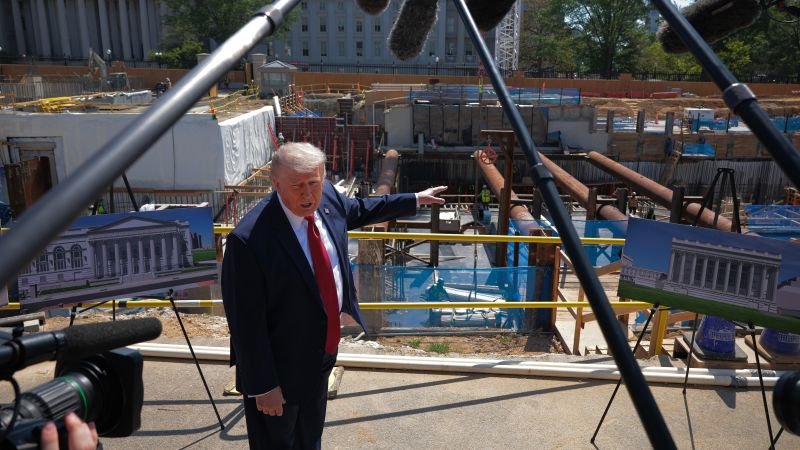
President Donald Trump is asking the Supreme Court to allow him to build a ballroom at the White House, citing previous threats to Trump’s life, national security needs and architectural values.
The emergency request filed Friday comes after lower courts repeatedly ruled that Trump needed approval from Congress before moving forward with the $400 million project.
The latest rebuke came last week, when an appeals court in Washington, DC, said the president lacked any authority to unilaterally pursue the planned ballroom and ordered him to stop work at the site of the former East Wing until lawmakers gave their blessing. But the court paused implementation of its decision for 14 days to give Trump time to appeal to the justices.
US Solicitor General John Sauer argued in the filing with the Supreme Court that the East Wing construction was “absolutely required “ for the president’s safety, noting the attempts that have been made on Trump’s life in recent years.
“The President of the United States of America is not a tenant, but rather the sole, elected head of the Executive Branch, and Congress has authorized him to renovate, secure, and protect the White House and its grounds, as other Presidents have been allowed to do, without exception,” Sauer wrote. “The injunction is ‘judicial overreach beyond the proper province of the federal courts.’”
The request is the first time any of Trump’s pet projects has landed before the Supreme Court. In recent months, lower courts sifting through a litany of cases challenging his plans to remake Washington have looked skeptically at his arguments defending his approach or issued rulings frustrating his pursuits.
In the ballroom case, the DC Circuit Court of Appeals agreed on August 7 with a federal judge’s ruling directing Trump to halt work on the above-ground portions of the ballroom. Both rulings permitted construction of a highly sophisticated bunker under the ballroom to continue.
“Whether or not a massive ballroom should be constructed is for Congress to decide and is not a matter for Executive self-help,” the DC Circuit said in its 2-1 ruling.
The case was brought last year by the National Trust for Historic Preservation, the nation’s top historic preservation group.
“The National Trust has shown, compellingly, that Congress has not ceded unfettered authority to the Executive Branch to dramatically redesign, reshape, and reconstruct the White House – the People’s House – to fit a particular President’s desires,” the appeals court concluded.
The Trump administration argued Friday that the carveout the lower courts made for continued construction of the security bunker was not enough, and said the order “threatens the security and safety of the President.”
“The entire ballroom structure is designed to shield the military installation beneath it,” Sauer wrote, “Halting the Project will stall this vital construction, making this President — the subject of recurrent assassination attempts — much less safe, and risking future Presidents’ safety.”
Above-grade construction on the ballroom began in the spring and has made considerable progress. Images posted by Trump in early August reveal multiple levels of concrete support columns and metal rebar amid a significant amount of construction equipment, including a tower crane.
The president has been personally involved in ballroom details, from floor plans to marble selection. The sprawling ballroom project has an estimated size of approximately 89,000 square feet, according to lead architect Shalom Baranes. By contrast, the primary White House structure, the Executive Mansion, is just 55,000 square feet.
Trump has maintained that the project isn’t subject to any oversight and that he should be able to continue with it without any serious scrutiny.
The administration said Friday that “Congress gave the President the power to make “alteration[s]” and “improvement[s]” to the White House “as the President may determine.”
Trump has said it will be finished in the summer of 2028, an expedited timeline for completion months before he leaves office.
His administration argued to the Supreme Court that freezing the construction at this stage “would create a veritable obstacle course for the Secret Service, further imperiling safety.”
“The partially finished, 70-foot concrete-and-steel superstructure ‘cannot be largely left alone at this point’ without tremendous setbacks that will fundamentally compromise the integrity of everything currently built there,’ not to mention the ‘major safety risk’ from leaving it with inadequate’ stability or strength to handle wind and heavy loads on [its] own,” Sauer said.
Friday’s filing said the ballroom’s design had been inspired by the Supreme Court “and, in particular, its magnificent Corinthian columns — considered the highest column order in architecture.”
The columns, made of the “highest-grade Indiana limestone” that had been shipped to Italy, “are being being carved by some of the greatest artists anywhere in the world,” Sauer said.
“Delivery and installation will begin shortly,” he said.
This is a developing story and will be updated.
Source link
See more: The Global Track