Newsletter Subscribe
Enter your email address below and subscribe to our newsletter
Enter your email address below and subscribe to our newsletter


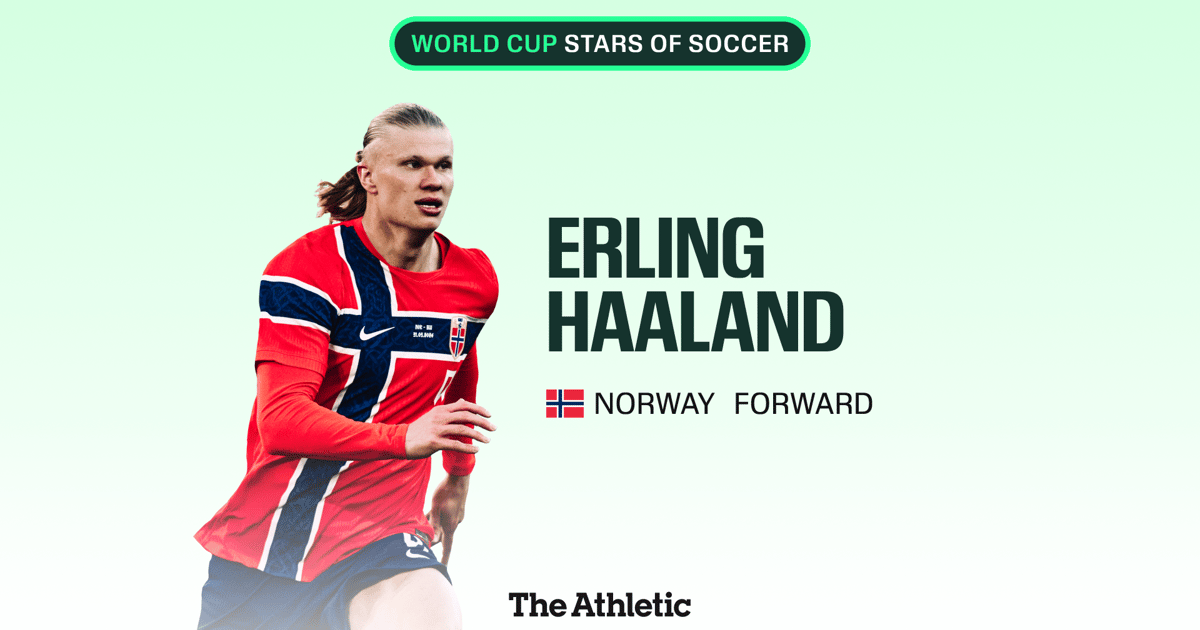
The Haaland family don’t have great memories of East Rutherford, the venue of the World Cup 2026 final.
Thirty-two years ago, Alf Inge Haaland, who had started Norway’s previous two games at World Cup 1994, was suspended for the final group game against the Republic of Ireland having collected bookings in both prior matches. Norway played out a 0-0 draw, which meant they somehow finished bottom of Group E, the strangest group in World Cup history, with all four sides finishing on four points. Haaland could only watch helplessly from the stands at the old Giants Stadium.
Much has changed since then; the Giants Stadium has gone, and the MetLife is there in its place. This summer, Erling Haaland will hope to put things right there.
The younger Haaland, it’s fair to say, is not much like his father – beyond the fact both are Norway internationals. Alf Inge was a tough-tackling defender or midfielder, and Erling is a striker. And he’s not just any striker, but the most pure striker football has seen for years.
In a world where centre-forwards are often converted from other positions, or can be re-deployed as a No 10 or out wide, Haaland’s game is very simple. He stays up front, he comes alive in the penalty box, and he finishes ruthlessly. There’s a debate about who the best footballer in the world is at the moment, but not such a debate about the best finisher. That is Haaland.
Goal threat
Box threat
Shot frequency
Creative threat
On-ball involvement
Compared to peers across Europe | Premier League, 2025-26
Metrics derived from The Athletic’s player roles model.
Haaland was born in Leeds in July 2000, thanks to his father playing for the club. But a month earlier, Alf Inge had signed for Manchester City. He wouldn’t have known it at the time, since at that point City were a middling Premier League club who had recently recovered from relegation to the third tier, but the next two decades of Erling’s life would become about him signing for City, too.
He moved back to Norway at the age of three, came through the academy at Bryne like his father and made his name at Molde under manager Ole Gunnar Solskjaer, who played for Norway at World Cup 1998.
From there he had a gradual route to the Premier League. He moved to Red Bull Salzburg in Austria at the age of 18, then Borussia Dortmund in Germany at 19, before moving back to Manchester at 21. By that point he was already established as a lethal goalscorer, and has won three Premier League Golden Boots in his four seasons at the club.
The question about Haaland, which might sound ridiculous considering he’s scored over 160 goals in just four years, is whether he’s actually made City better.
They won the Champions League in his first season there, although Haaland was quiet in the latter stages. They’ve won two league titles in his four years, although they won two league titles in the two seasons before he joined, too. But, most strikingly, in the four league campaigns since Haaland joined, City haven’t actually equalled the number of goals they scored in the season beforehand, when their top goalscorer managed just 15 goals, a tally Haaland would consider a failure. It remains uncertain that basing your side around one dominant goalscorer who does little else is a benefit.
For Norway, Haaland has a goalscoring return of 55 goals in 49 matches, having surpassed the previous national record of Jorgen Juve, which stood since 1937. But this will be his first international tournament.
Norway’s record in international football this century is appalling, having not qualified for a major tournament since Euro 2000, just before Haaland’s birth. But their performance in qualification was excellent, winning all eight matches, including home and away wins over the biggest absentees from this competition, Italy. There are some weaknesses in the side, but they’re able to count upon the best penalty-box striker at the World Cup and, when fit and on form, one of the best creators in Arsenal captain Martin Odegaard.
Norway also have other decent striking options in Alexander Sorloth and Jorgen Strand Larsen, both regular goalscorers in top leagues. Ideally, perhaps they’d have a player of that quality elsewhere on the pitch rather than as understudy to Haaland. Interestingly, neighbours Sweden have a similar issue, with Alexander Isak and Viktor Gyokeres leading the line for big Premier League clubs. At a time when Europe isn’t producing many proper strikers, Scandinavia seems something of an exception.
Haaland plays for Norway much as he does for Manchester City. In fairness, he’s shown signs of improving his all-round game and particularly his link play over the past year, which might be necessary if Odegaard’s recent struggles continue. But, by modern standards, he is almost solely a goalscorer. He prefers his left foot but can finish with his right comfortably. He’s excellent in the air. He’s good at peeling off into deeper positions to finish cut-backs, but he’s particularly prolific when able to hang deep at the far post and wait for tap-ins. For such a player of physical power – son of a professional footballer and a Norwegian heptathlete – not a huge number of his goals involved outmuscling defenders. Haaland is much more likely to find space by making a clever run at the right time, going undetected by opponents.
Average
shot distance
11.7 yards
Premier League, 2025-26
Winning the World Cup might be beyond Norway, but Haaland will surely figure highly in the race to win the tournament’s top goalscorer award. Being drawn in a group alongside France and Senegal makes life tricky in that respect, although Haaland versus Iraq might be the most likely fixture to produce a hattrick in recent World Cup history. Above all else, it will be enjoyable to see him on the world stage for the first time. The World Cup needs the biggest stars, and as the best goalscorer in world football, it wouldn’t have felt right without Haaland.
Source link
See more: The Global Track