State Farm Is Embroiled in Scandal—and Things Just Got Worse

State Farm Is Embroiled in Scandal—and Things Just Got Worse

In 2021, a State Farm “captive agent” told a company sales leader that attempting to get information about claims out of company reps and adjusters was like talking to members of a “secret society.” The agent was not a member of the club—State Farm captive agents technically work for themselves under contract to the company—and the difficulty of getting straight answers made it look to the agent like the claims department wasn’t doing its job.

Or, perhaps, it was doing its job just fine.

The agent’s concerns are contained in court documents recently unsealed in Comanche County, Oklahoma. They are part of a long-running legal battle between State Farm and thousands of Oklahoma homeowners who say that the company has deliberately worked to reduce payouts on claims of roof damage following severe wind-and-hail events in the state. The fight has drawn the interest of Oklahoma’s government and become an issue in the state’s gubernatorial race.

The documents, which were released late last week, show that the agent was not alone; numerous other State Farm contractors were sounding internal alarms over what appeared to be a company-wide scheme to lowball distressed claimants.

The story starts in June 2020—June 26, to be precise, according to the new documents. That’s when a plan to systematically reduce indemnity costs, which I will refer to as the Wind/Hail Initiative, was launched in Texas. Within six months, the plan was rolled out to other states, including Oklahoma. (State Farm has defended its tactics as ordinary business operations.)

Roofers across Oklahoma quickly noticed that State Farm had stopped paying out fully on roof replacement claims. In doing so, the company seemed to be following in the footsteps of Allstate, which decades earlier had implemented a similar “process” to arbitrarily reduce payouts on roof damage. Many policyholders lawyered up, and soon, there were dozens of bad-faith roof-claim cases quietly moving through Oklahoma courts. From 2020 to 2024, plaintiffs fought to gain access to secret documents that remained under protective orders even as they were said to prove the existence of a scheme to defraud Oklahoma policyholders of hundreds of millions of dollars.

Today, there are more than 1,000 legal cases against State Farm in Oklahoma, and the effort to hold insurance conglomerates responsible has turned political. Republican Oklahoma Attorney General Gentner Drummond, as he vies for the governorship of the state in a primary runoff to be held Tuesday, has intervened in ongoing litigation and filed lawsuits against both State Farm and Allstate.

Drummond may be said to have staked his candidacy on his defense of Oklahoma homeowners, who, despite paying twice the national average for homeowners insurance, have for years found their claims of hail damage to be denied at a mysteriously elevated rate. Drummond’s runoff opponent, a Trump-endorsed former state senator named Mike Mazzei, has come to the defense of insurance carriers, even as Oklahoma polls show bipartisan distaste for insurance companies and as President Trump has publicly upbraided State Farm.

Now, at the final hour before the runoff, an initial tranche of the so-called State Farm Documents is finally coming to light.

My own insurance odyssey launched in early 2025, when the editor of a small Oklahoma nonprofit journalism outlet asked me to look into homeowners insurance in the state.

In May 2025, I published the first article of what would prove to be approximately 50,000 words’ worth of insurance stories. The maiden effort focused on Oklahoma Insurance Commissioner Glen Mulready’s sneaky ploy to spread a false claim—via The Wall Street Journal — that hail alone, and not insurance companies’ policies, explained Oklahoma’s outsize homeowners rates.

A couple of months later, I received an anonymous text from someone familiar with my coverage, advising me to attend an upcoming hearing in a case known as Nida v. State Farm.

Nida was a consolidation of nine cases, which in turn were representative of 125 bad-faith cases against State Farm. The cases were remarkably similar: A home would suffer approximately $30,000 in damage, and State Farm would produce a lowball offer of 10 percent of that amount in compensation.

The hearing was held in a cavernous old courtroom in Oklahoma City, with great murals on the walls, ancient nicotine stains on the ceiling, and enough hard wooden pews to accommodate the indicted congregation of a megachurch. But apart from the attorneys, I was only one in the echoey room.

The Nida cases, I learned, had been settled more or less immediately after plaintiffs’ attorneys won access to the secret documents and began deposing State Farm executives. The documents remained under a protective order because the cases were settled. But then State Farm briefly—and accidentally, the company later claimed—made the terms of the settlements public. A new lawsuit was filed, and in court, I witnessed one of the plaintiffs’ attorneys reveal the settlement amount of just one of the 125 cases.

Not $30,000. Not $50,000 or $100,000. Just one case settled for $3 million.

Multiply that by 125. Round down to be safe (not everyone would have necessarily been in line for such an eye-popping payout). That’s how much State Farm appeared willing to pay to protect the secret documents.

The Nida case is ongoing, but that was not State Farm’s biggest problem. Their problem was that it never stopped hailing in Oklahoma.

In early December, I wrote about a denied claim from a Tulsa police lieutenant named Billy Hursh, a kind and clean-cut man who, alongside his wife and son, exhibited the nostalgic charm of a Hummel figurine. With that, the trickle of cases turned into a deluge. A fellow journalist later told me that she noticed 10 new roof claim cases being filed every day in courts across the state.

A few days after my Hursh piece ran, Attorney General Gentner Drummond filed to assist in the cases. Drummond charged that State Farm had committed racketeering offenses. (It wasn’t the first time that State Farm had been threatened with RICO laws. In 2018, the company paid $250 million to wriggle out of a lawsuit that alleged it had purchased a seat on the Illinois Supreme Court.)

It was about then that the Oklahoma Supreme Court got involved, with both the secret documents and the AG’s intervention. State Farm was producing writs of prohibition like they were gobbling aspirin, and I wrote about another bad-faith case: The insurance company was fighting tooth and nail to deny the roof claim of none other than a retired chief justice of the Oklahoma Supreme Court.

I wrote stories about secret documents from the past. A State Farm whistleblower from the 1990s—a woman who has since gone missing—left behind a sheaf of documents that were leaked to her after she appeared on an episode of 60 Minutes. Other pleadings in Oklahoma sneaked in details of the “process” that Allstate had first tried out on residents of Albuquerque, New Mexico, in 1997.

All the while, both plaintiffs’ attorneys and lawyers for State Farm refused interview requests about the rapidly accumulating cases in Oklahoma. (State Farm’s corporate media center has also consistently refused requests for interviews with State Farm executives.)

Then word came: A judge in Comanche County had ordered State Farm to produce 800,000 documents. State Farm did so, but designated all 800,000 documents confidential. The plaintiffs argued that this was in violation of Oklahoma law, and the judge agreed. He ordered the release of 31 documents out of the 44 requested by attorneys, totaling 159 pages. It was the first time any of the State Farm Documents had become public. I drove three hours to Comanche County to grab them before State Farm could file a stay.

One figure at the heart of the Great Oklahoma State Farm Roof Claim Saga is a woman named Nicole Manduca, a 27-year State Farm veteran who rose through the ranks from claim representative to senior leader and director of property and casualty operations, among other titles.

In previous stories, I had reported that Manduca had bragged about setting an arbitrary goal of a 50 percent reduction in payouts in the Wind/Hail Initiative, representing billions of dollars of denied claims. The new documents reveal that early in 2020 Manduca identified full roof replacements on wind and hail claims as the company’s “biggest bucket of opportunity” for reducing claim payouts.

In newly released e-mail and text exchanges, Manduca frequently referred to what she called “the hypothesis”: Before 2020, she said, State Farm was awarding full roof replacements on 85 percent of small hail-damage claims and 65 percent of wind claims. Citing data from the consulting giant Accenture, Manduca claimed that nationwide “averages” on hail and wind roof replacements were 8–10 percent and 5 percent, respectively.

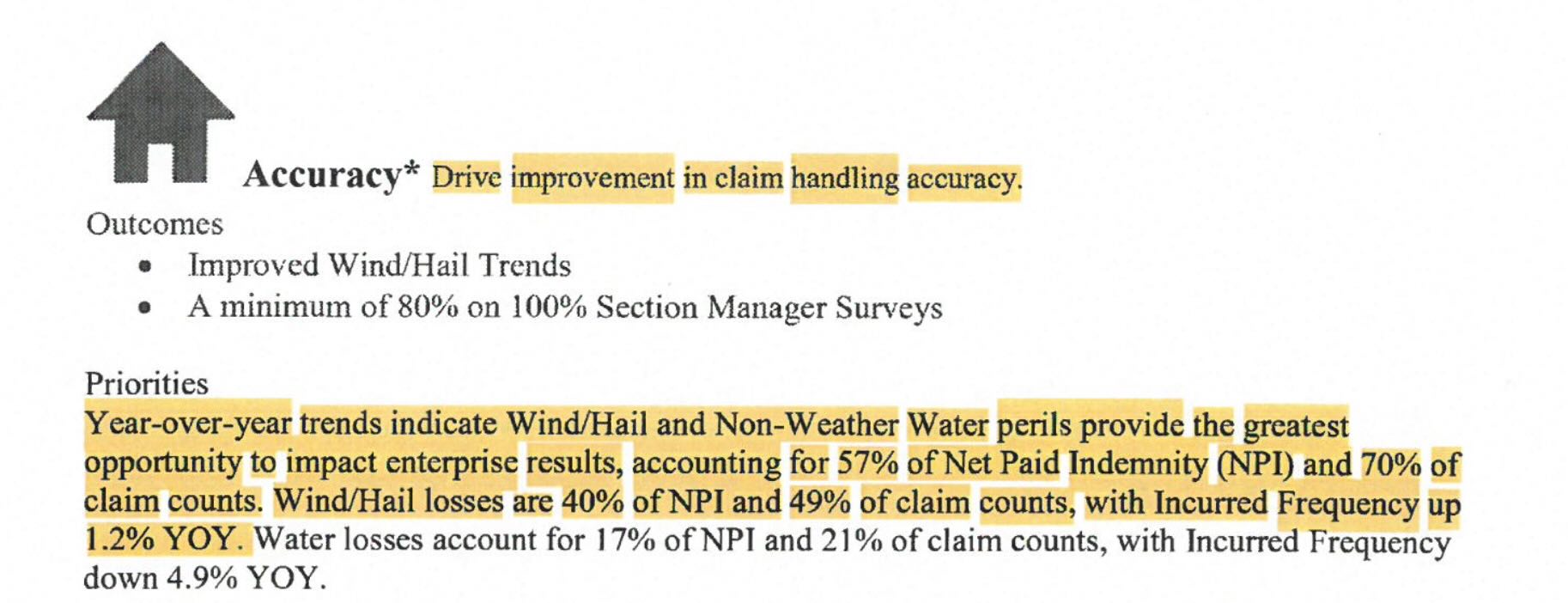
From a 2020 report indicating that “Wind/Hail and Non-Weather Water perils provide the greatest opportunity to impact enterprise results.”

Presumably, “the hypothesis” was that State Farm could save a load of money if full roof replacement rates were in line with the nationwide “average.”

To understand that bit of sophistry, you have to step into the past.

Insurance companies have always sought to finesse extra profits. The lunge toward greed, however, took a quantum leap forward in the 1990s, when Allstate called on corporate supervillain McKinsey and Company to help the insurance industry scrappily claw its way from highly profitable to too big to fail.

That’s where the story starts repeating. After receiving a McKinsey “fact-gathering” report totaling more than 12,000 pages, Allstate identified the best area in which to pursue “opportunity dollars”: roof damage in wind and hail claims. In the years to come, Allstate would secure Accenture data suggesting that nationwide roof replacement rates were significantly lower than what certain companies were then paying out.

There was a problem, however. The Accenture data that first Allstate, and then State Farm, claimed to rely on has proven impossible to verify. When asked to provide evidence of the data in court, State Farm’s lawyers were forced to say that they couldn’t.

In devising and championing the Wind/Hail Initiative in Dallas in 2020, Manduca and several other State Farm executives repeated what Allstate did in Albuquerque in 1997. Both got caught with their hand in the cookie jar and paid a price (Allstate has lost multiple court cases over the past two decades), but not enough of a price to change their behavior—at least so far.

The insurance giants also got help from the courts. In a landmark 2003 decision in Campbell v. State Farm, the Supreme Court shot down a $146 million punitive judgment against the company, effectively inoculating it against the kind of massive award that might actually compel a corporate bad actor to change its reprehensible ways.

Apart from the decision, the oral argument in Campbell v. State Farm is notable for a quote from Justice Antonin Scalia. Rather than the sort of flippant quip that has solidified Scalia’s legacy as a conservative icon, his comments in Campbell were a plaintive call, a winsome acknowledgement that there were few ways left to hold insurance companies accountable.

“No amount of money will suffice; maybe we have to send them to jail,” Scalia said. “Whatever it takes to stop them. I mean, what if nothing will stop them but sending them to jail?”

They don’t just come out and say it.

The internal State Farm documents read like the faux-sacred texts of a Ponzi scheme cult. Neutered acronyms abound. The documents speak of “quality” when they mean “arbitrarily reducing payouts.” An increased “error rate” means an employee is not being sufficiently ruthless in denying claims. The “Art of the Conversation,” a training module offered to claims handlers tasked with delivering news of claim denials to insureds, is the whitewashed process of teaching a human being to be cruel to another human being.
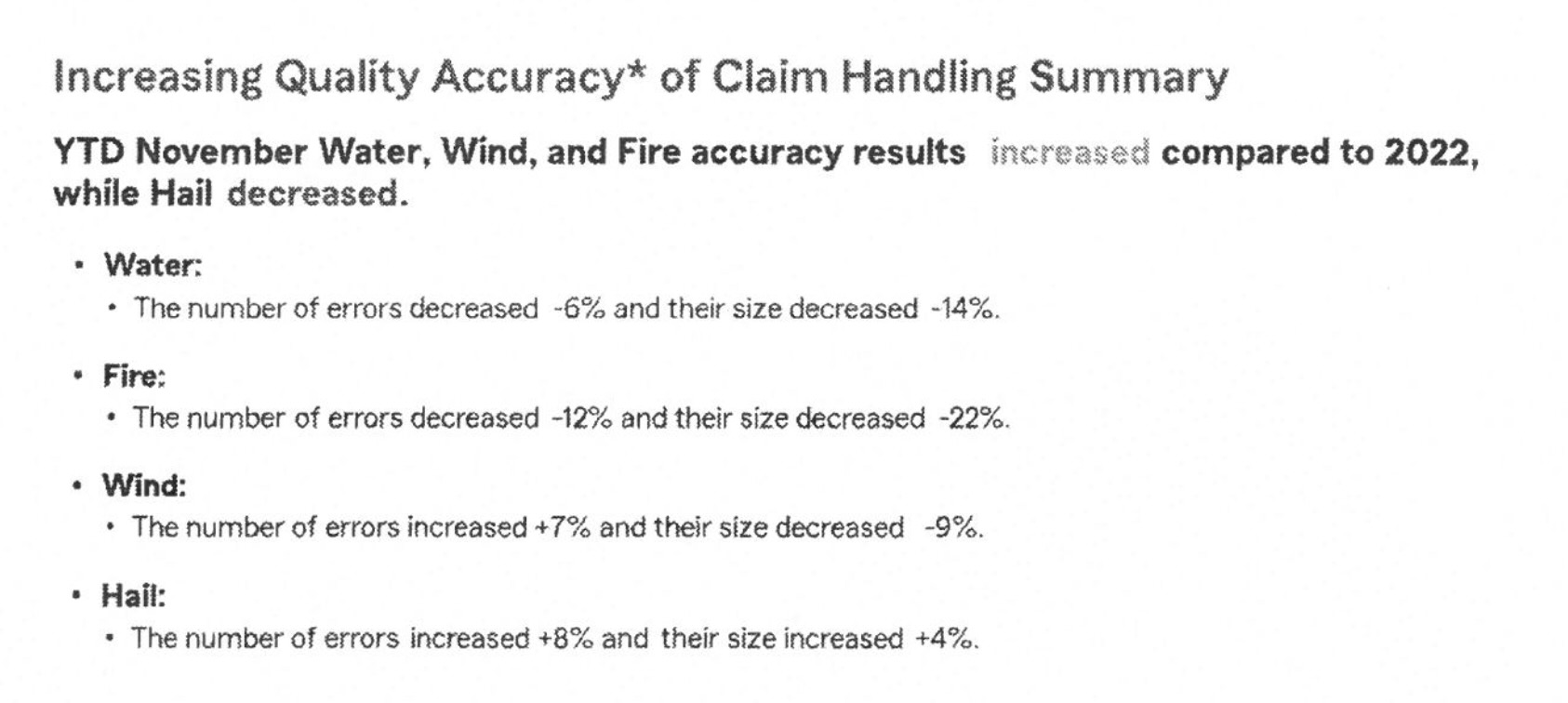
Accuracv* Drive improvement in claim handling accuracy Outcomes • Improved Wind/Hail Trends • A minimum of 80% on 100% Section Manager Surveys Priorities Year-over-year trends indicate Wind/Hail and Non-Weather Water perils provide the greatest opportunity to impact enterprise results, accounting for 57% of Net Paid Indemnity (NPI) and 70% of claim counts. Wind/Hail losses are 40% of NPI and 49% of claim counts, with Incurred Frequency up 1.2% YOY. Water losses account for 17% of NPI and 21% of claim counts, with Incurred Frequency down 4.9% YOY.
A report on “error rates” found in the documents.

What becomes palpable in the documents is that the biggest problem the insurance companies had in implementing craven profit initiatives was the reluctance of managers and agents and claim handlers to get fully on board. Internal communications often read like the goofy rhetoric of a cult leader scheming the best way to turn desperate initiates into brainwashed acolytes.

Hence, Nicole Manduca, in the early months of the 2020 rollout in Dallas, wrote in newly released text exchanges to colleagues that “expanding/broadening management review on higher hail/wind severity threshold nets us the most gain.” In other words, get your managers in line, or it doesn’t work.

Manduca’s nervousness is apparent as she sweats data from the early months (“Concerned to see the larger % for Wind and Hail is flat”), as is her excitement when tools become available to track data on the Wind/Hail Initiative (“I’m drooling. :o3:o3:o3”).

kathy.ress. nicole. manduca. Would love to kathy.ress. kathy.ress. Will that work for you? nicole.manduca i'm drooling :03:03:03 kathy.ress lol! [2021-03-03 20:21:27 (UTC)]: WIll you have W/Hdashboard ready for next month quality check in we could highlight in this call? |2021-03-03 20:21:44 (UTC)|: 12021-03-03 20:22:19 (UTC)]: Very good. We're going to focus on Wind/Hail TX, IL and GA. and the FME dashboard [2021-03-03 20:22:23 (UTC)]: |2021-03-03 20:23:04 (UTC)|: [2021-03-03 20:23:34 (UTC)]: nicole.manduca • [2021-03-03 20:24:19 (UTC)] Passion project. am so excited and optimistic (and I believe steeped in reality) that we WILL realize improvements in Wind/Hail trends in '21
Nicole Manduca calls the Wind/Hail initiative a “passion project.”

By 2023, the jury was in: The Hail/Wind Initiative was wildly profitable, with $1.4 billion in reduced indemnity from 2020 to 2021. Before the initiative, Manduca reported internally, State Farm replaced 5.6 roofs for every roof they repaired. Since then, the number of total roofs replaced had fallen to 2.1. The Wind/Hail Initiative was reaping billions.
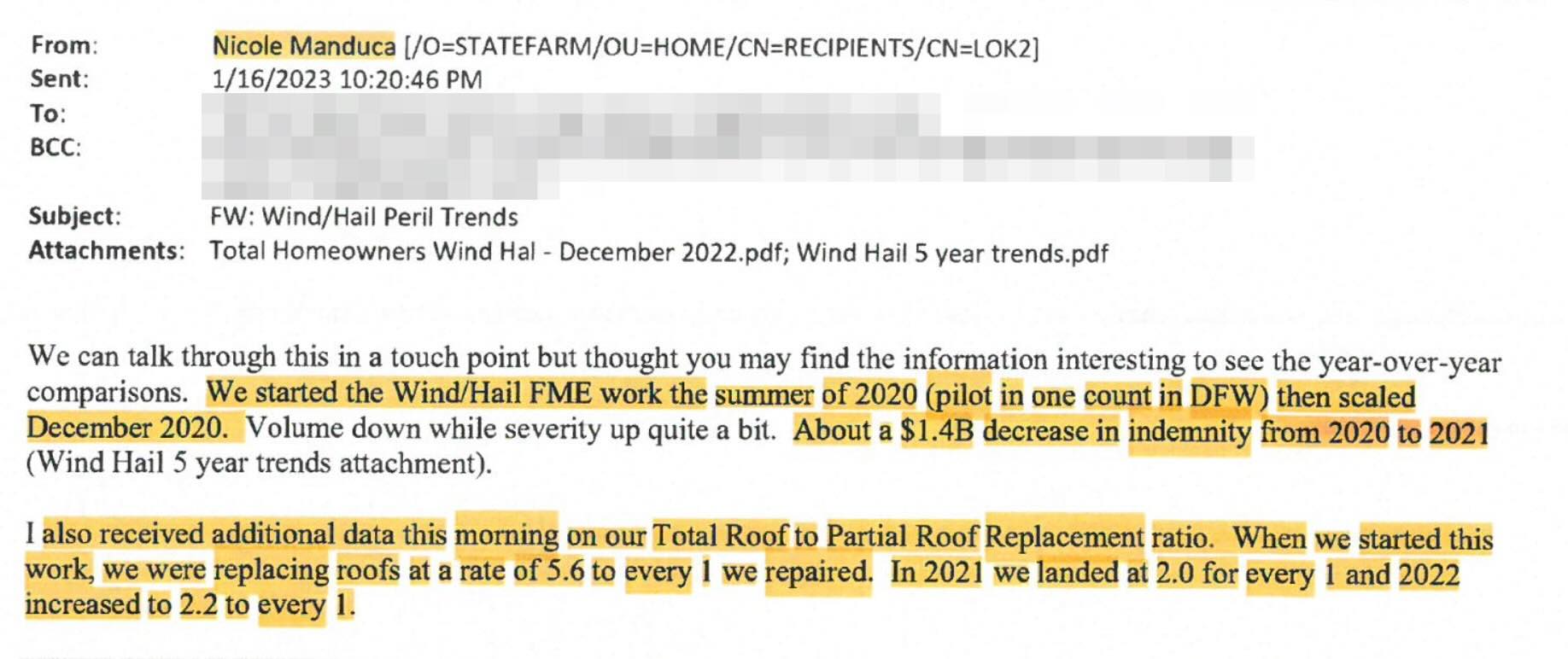
From: Sent: To: BCC: Subject: Nicole Manduca [/0=STATEFARM/OU=HOME/CN=RECIPIENTS/CN=LOK2] 1/16/2023 10:20:46 PM FW: Wind/Hail Peril Trends Attachments: Total Homeowners Wind Hal - December 2022.pdf; Wind Hail 5 year trends.pdf We can talk through this in a touch point but thought you may find the information interesting to see the ycar-over-year comparisons. We started the Wind/Hail FME work the summer of 2020 (pilot in one count in DFW) then scaled December 2020. Volume down while severity up quite a bit. About a $1.4B decrease in indemnity from 2020 to 2021 (Wind Hail 5 year trends attachment). I also received additional data this morning on our Total Roof to Partial Roof Replacement ratio. When we started this work, we were replacing roofs at a rate of 5.6 to every 1 we repaired. In 2021 we landed at 2.0 for every 1 and 2022 increased to 2.2 to every 1.

In August 2023, even as bad-faith roof cases had begun to pile up in Oklahoma, the newly released documents show that the Wind/Hail Initiative had become a subject of discussion at weekly meetings of a group known as the Fix Profit Task Force. In short, State Farm wasn’t concerned by the roof claims in Oklahoma or the tens of millions of dollars they would pay to make those cases go away. Instead, they doubled down, and now the very highest reaches of State Farm were getting involved. The morning meetings of the Fix Profit Task Force were called by State Farm CFO Jon Farney, who would soon be promoted to become just the sixth CEO in State Farm’s 104-year history.

Letters from three State Farm captive agents embedded in the documents released last week—each written as the Hail/Wind Initiative took hold, and each expressing an alienation from the company that was identical to the agent who said it operated like a secret society—tell the story of what has become of an iconic American brand.

An August 2021 letter from Dublin, Ohio–based State Farm agent Chad Harris described his experience of getting pulled into a claim dispute but being unable to communicate with anyone from State Farm’s claims department. Harris complained that claims were now being handled by outside contractors, and that no one at State Farm was empowered to resolve a conflict.

“This is terribly embarrassing for State Farm…and me, as the local agent,” Harris wrote. “This claim highlights all the current dysfunction within our SF claims operations and processes.”

Two months later, Louisville, Kentucky–based State Farm agent Tracy Haus wrote to leadership to say that although she “bleeds State Farm logos” she was now worried for State Farm’s reputation: reputable companies, she said, were now saying that State Farm was no different from Allstate.

“The old slogan of ‘we pay what we owe, not a penny less, not a penny more,’ is not the case right now,” Haus wrote. “We now pay really low and customers fight to get what we owe them in more and more cases…. We need a drastic change before it’s too late.”
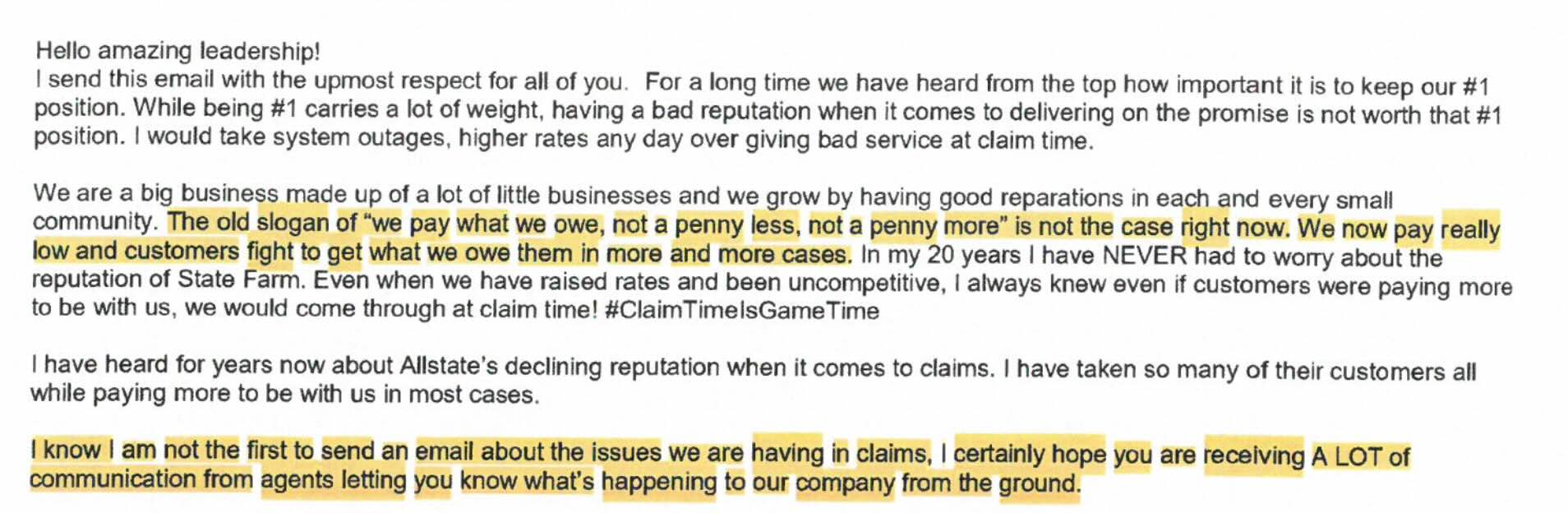
Hello amazing leadership! I send this email with the upmost respect for all of you. For a long time we have heard from the top how important it is to keep our #1 position. While being #1 carries a lot of weight, having a bad reputation when it comes to delivering on the promise is not worth that #1 position. I would take system outages, higher rates any day over giving bad service at claim time. We are a big business made up of a lot of little businesses and we grow by having good reparations in each and every small community. The old slogan of "we pay what we owe, not a penny less, not a penny more" is not the case right now. We now pay really low and customers fight to get what we owe them in more and more cases. In my 20 years I have NEVER had to worry about the reputation of State Farm. Even when we have raised rates and been uncompetitive, I always knew even if customers were paying more to be with us, we would come through at claim time! #ClaimTimelsGameTime I have heard for years now about Allstate's declining reputation when it comes to claims. I have taken so many of their customers all while paying more to be with us in most cases. I know I am not the first to send an email about the issues we are having in claims, I certainly hope you are receiving A LOT of communication from agents letting you know what's happening to our company from the ground.
A message from a State Farm agent concerned about the impact of the roofing insurance policies.

Two weeks after Haus’s letter, Massillon, Ohio–based State Farm agent Robert Garner wrote to leadership to describe the impact of a denied roof claim on his business. He was losing multiple clients over a single claim, Garner said, and, like Harris, he was struggling to communicate with the claims department.

“This is just one example of many other clients that feel the same way,” Garner wrote. “This is the first time in my 15 years I have had any issue with claims.”

What the agents failed to perceive in 2021—that being sidelined in the claim process was all part of the Wind/Hail Initiative—must have become apparent in May of this year, when State Farm announced pay cuts of 35–40 percent for 19,000 captive agents across the country.

The Great Oklahoma Roof Claim Saga has reached a fever pitch.

Today, when I attend a State Farm hearing in Oklahoma, there are generally three or four reporters in the courtroom, and cameras waiting in the hallway representing most of the media outlets in the state. Plaintiffs’ attorneys have begun giving interviews. Morose State Farm lawyers continue to refuse comment.

Tuesday’s runoff election may signal whether Oklahomans are tired of feeble excuses for skyrocketing homeowners rates and the arbitrary denial of valid claims from wildly wealthy insurance companies.

Regardless of the outcome of the election, the litigation will continue. Trial dates that took months to secure are rapidly approaching, and in the same case that forced State Farm to hand over 800,000 documents, plaintiffs’ attorneys were granted a deposition of State Farm CEO Jon Farney. In a separate case, Nicole Manduca will be deposed as well—for the third time.

Two questions remain. First, will State Farm once again settle out of court, not for tens of millions of dollars for 125 cases this time, but for whatever it will take to quash 1,000 outstanding Oklahoma cases? And second, will plaintiffs’ attorneys and attorneys general across the country follow the lead of Oklahoma and further compound State Farm’s woes?

More from The Nation
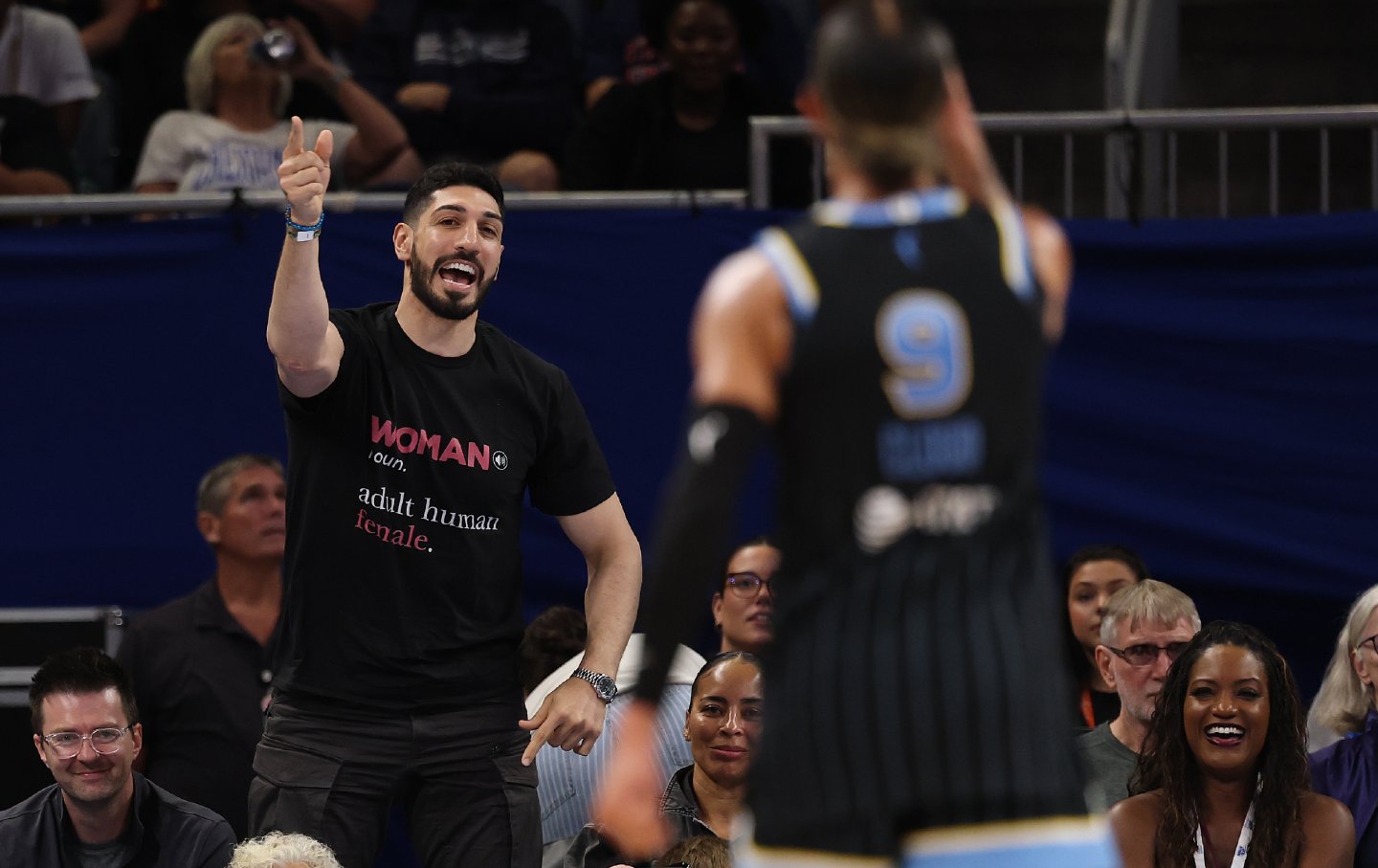

Former basketball player Enes Kanter Freedom and Natasha Cloud of the Chicago Sky confront each other during a Chicago Sky and Indiana Fever game on August 23, 2026, in Chicago.

The trans women in sports panic is nothing but a stalking horse for permitting violence against trans people—and we should celebrate players like Natasha Cloud who say so.

Dave Zirin


Road Trip to Nowhere

Transportation Secretary Sean Duffy’s reality show is an ungainly mix of corporate corruption and MAGA agitprop.

Henry Burke


An abortion-rights demonstrator holds a sign in front of the US Supreme Court as the “Medina v. Planned Parenthood South Atlantic” case is heard on April 2, 2025.

Melanie Folwell writes that a post-viability limit is the right choice for a citizens’ initiative in Idaho, but Erika A. Christensen argues that restrictions are never acceptable….
The Debate

/

Melanie Folwell and Erika A. Christensen


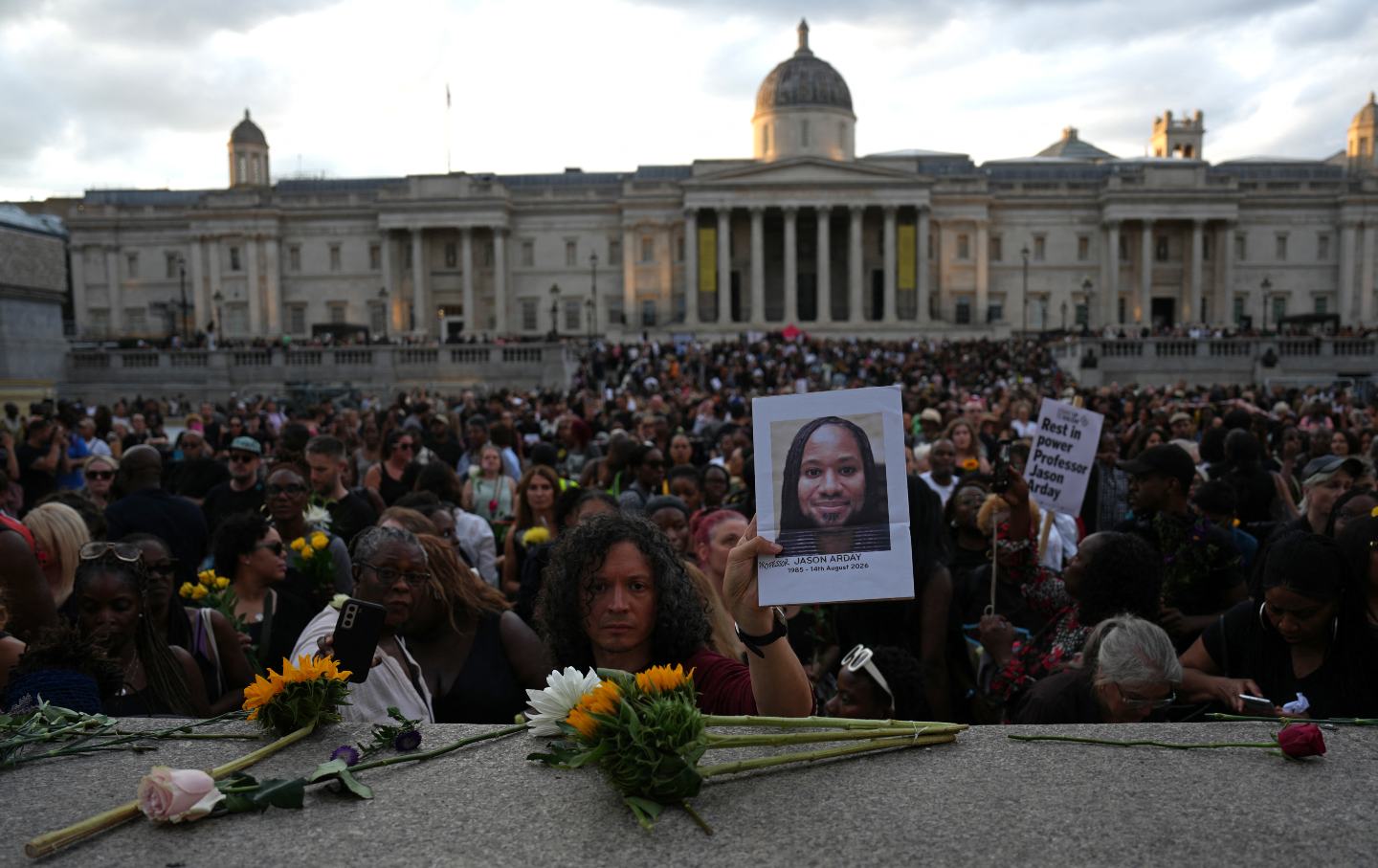
Supporters leave flowers and photographs after taking part in a vigil for late Cambridge professor Jason Arday in Trafalgar Square in central London on August 17, 2026, following his death at age 41 on August 14.

I was one of the few Black scholars at both institutions. I understand—and loathe—how their tendency to undermine the suffering of Black people led to Jason Arday’s demise.

Gazelle Mba


Mais Notícias

Home Page – Início

Source link
See more: The Global Track
Corinthia Mes

Golden State Valkyries face Minnesota Lynx looking to avenge recent loss

Golden State Valkyries face Minnesota Lynx looking to avenge recent loss

The Valkyries’ identity has taken the organization to the precipice of the league’s summit. Yet as Golden State prepares for Monday’s rematch with the title-contending Minnesota Lynx, it is becoming increasingly likely that its ethos might also keep it from taking that final step. 

In its second year, Golden State has leaned on a team-first philosophy. A bundle of good-not-great ballers who suffocate defensively and hit just enough shots to make it all work. 

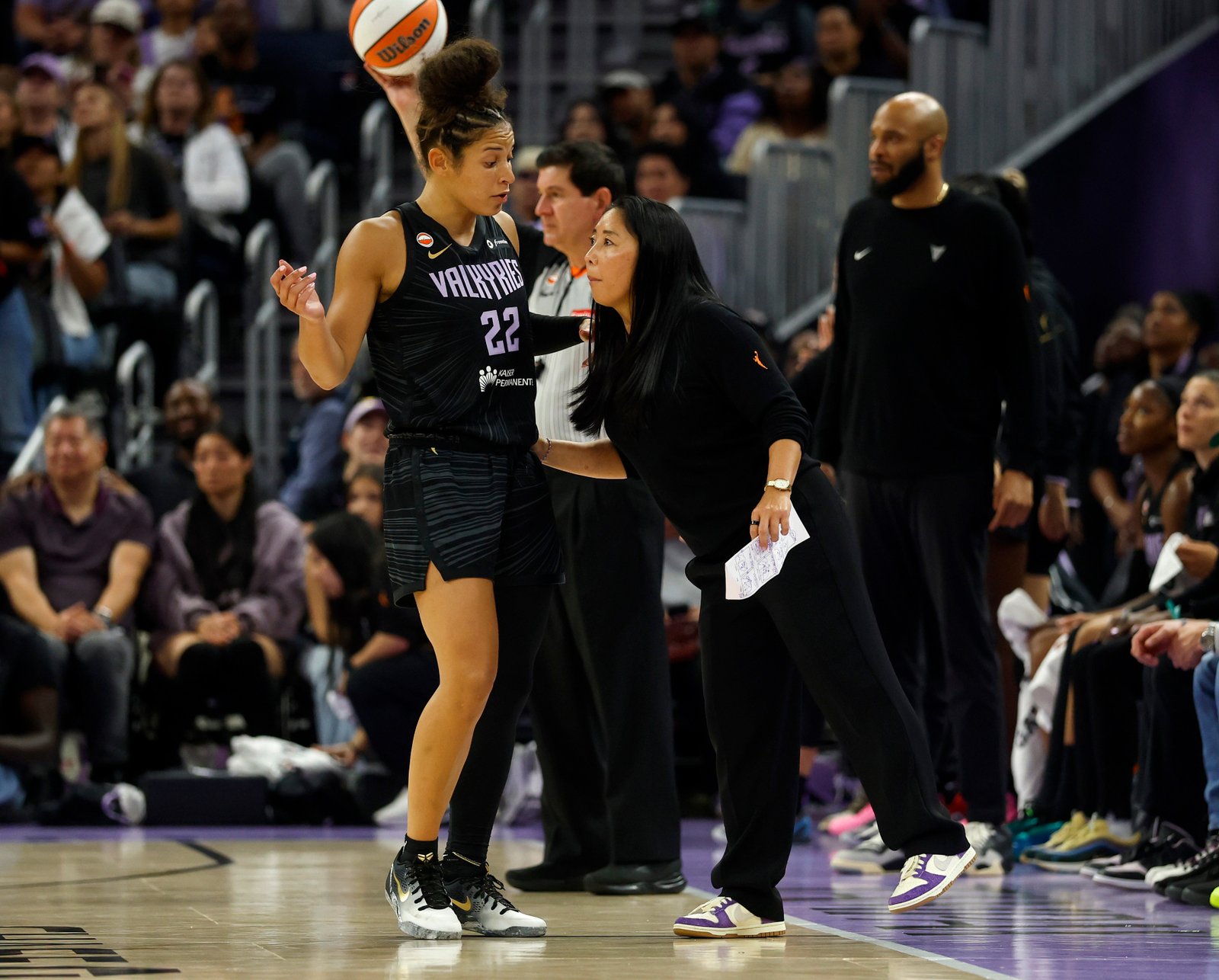
Deftly led by coach Natalie Nakase and headlined by unheralded yet effective talents such as Veronica Burton and free agent signing Gabby Williams, the Valkyries have run off winning streaks of nine and six games this season. 

With not a single player cracking even 30 minutes per game, the WNBA’s best team in both defensive rating and points allowed per game has been a masterclass of collective brilliance. 

Entering last week, the Valkyries, then 25-9, were the league’s hottest team and had seemingly proven themselves a triumph of plurality over individuality. Then came the reality checks named Napheesa Collier and Olivia Miles. 

With Collier and Miles, the star-studded Lynx waltzed into Chase Center, coined “Valkatraz” by guard Tiffany Hayes, on Wednesday and demonstrated that high-caliber shotmakers are not phased by a hand in the face. 

Miles had 20 points and eight assists, and Collier scored 18 points on a diet of tough turnarounds. After losing 77-66, the Valkyries eagerly looked ahead to the rematch scheduled a few days later. 

“I know that was a playoff feeling type of game, and I really love those. I can’t wait for the next one,” Hayes said. 

Then came woebegone Chicago, a perennially dysfunctional outfit that should have been an easy Friday appetizer before Monday’s main course. 

Instead, the Valkyries offense cratered for a half, Sydney Taylor broke hearts in the final minute in a 73-70 defeat, and now the team’s momentum is nowhere to be found. 

And while Taylor’s stepback in crunch time and Collier’s unblockable fadeaways hurt, the back-to-back losses might have also revealed that the issue lies more with the Valkyries’ offense. 

Golden State has rightfully touted its everybody-eats offense. Whether it be Williams or Kaitlyn Chen, Nakase’s unit rides the hot hand. Against most teams, that has worked. When it has not, the defense has typically been so astute it has not mattered.

Golden State Valkyries’ Janelle Salaün (13) and Golden State Valkyries’ Kiah Stokes (41) defend against Toronto Tempo’s Kiki Rice (1) in the fourth quarter at the Chase Center in San Francisco, Calif., on Tuesday, Aug. 4, 2026. (Nhat V. Meyer/Bay Area News Group) 

With Kelsey Plum on the trade market, the Valkyries declined to present a better offer than Phoenix’s for the high-octane scorer who averages over 20 points per game. For a while, that seemed like the no-brainer non-move. 

But lately, the attack’s biggest weakness has begun to show: The team cannot create easy shots. The Valkyries lack stars, and nowhere is it more apparent than when one takes a look at the stats.

Golden State ranks seventh out of 15 teams in offensive rating (110.4), scores the third-fewest points per game (82.5), and plays at the slowest pace. With that pace, the walk-it-down-the-floor philosophy means the Valkyries often face set defenses.

According to the WNBA’s own website, the Valkyries have three players – Ceci Zandalasini, Janelle Salaun and Veronica Burton – ranked in the bottom 10 for lowest expected field goal percentage. Williams is right outside at the 12th lowest among qualified players. 

Mais Notícias

Home Page – Início

Source link
See more: The Global Track

Corinthia Mes

2026 Michigan State Senate Primary Election Results

2026 Michigan State Senate Primary Election Results

Find primary election results for all State Senate races in Michigan

WDIV Decision 2026 (WDIV)

Here’s where you’ll find the 2026 primary election results for Michigan’s State Senate race.

Find which district you reside in here.

Here are the results:

2026 Michigan State Senate Primary Election Results


State Senate Primary Election Results (All)

Justin Onwenu (D)

8,33864%

Abraham Aiyash (D)

4,59736%

99.3% of Precincts Reporting

(133 / 134)

100% of Precincts Reporting

(87 / 87)

John Conyers III (D)

5,60228%

LaTanya Garrett (D)

1,4397%

Kimberly Hill Knott (D)

9325%

99.3% of Precincts Reporting

(152 / 153)

Stephen Jensen (D)

2,76013%

*Incumbent

100% of Precincts Reporting

(151 / 151)

Shadia Martini (D)

14,99034%

Rakesh Ramakrishnan (D)

4,28510%

1.1% of Precincts Reporting

(1 / 88)

Theresa Brooks (D)

7,20844%

Brendan Johnson (D)

4,65328%

2.7% of Precincts Reporting

(2 / 73)

Amanda Treppa (D)

11,16226%

1.2% of Precincts Reporting

(1 / 86)

Veronica Klinefelt *(D)

5,91549%

Alysha Johnson (D)

4,71339%

*Incumbent

15% of Precincts Reporting

(12 / 80)

10.1% of Precincts Reporting

(7 / 69)

1.1% of Precincts Reporting

(1 / 90)

Michael White (D)

8,11923%

0% of Precincts Reporting

(0 / 77)

72.8% of Precincts Reporting

(83 / 114)

Chris Moraitis (R)

2,52753%

Kenny Clevenger (R)

1,50732%

39.8% of Precincts Reporting

(39 / 98)

Margarette Gupta (D)

10,42344%

1.2% of Precincts Reporting

(1 / 80)

Daniel Lawless (R)

10,61839%

1.2% of Precincts Reporting

(1 / 80)

Frank Borsellino (D)

2,94848%

0% of Precincts Reporting

(0 / 66)

Douglas Wozniak (R)

6,24269%

Terence Mekoski (R)

2,78831%

0% of Precincts Reporting

(0 / 66)

Randy Schultz (R)

2,37914%

52.9% of Precincts Reporting

(73 / 138)

Brendan Johnson (D)

2,32561%

Martin Cousineau (D)

1,49039%

25% of Precincts Reporting

(25 / 100)

Matthew Bierlein (R)

3,09556%

Gabriel Lossing (R)

90616%

25% of Precincts Reporting

(25 / 100)

0% of Precincts Reporting

(0 / 92)

Rashida Harrison (D)

3,77448%

Mark Polsdofer (D)

2,37830%

12.8% of Precincts Reporting

(12 / 94)

Abbie Groff-Blaszak (D)

10,30754%

44.6% of Precincts Reporting

(33 / 74)

Rickie Kreuzer (D)

4,02317%

54.3% of Precincts Reporting

(44 / 81)

8.6% of Precincts Reporting

(8 / 93)

Michael Markey (R)

2,12626%

8.6% of Precincts Reporting

(8 / 93)

25% of Precincts Reporting

(28 / 112)

Thomas Norton (R)

3,23316%

67.2% of Precincts Reporting

(80 / 119)

*Incumbent

67.6% of Precincts Reporting

(100 / 148)

Chadwick Twillman (R)

53811%

70% of Precincts Reporting

(63 / 90)

Mitchell Treadwell (D)

3,02921%

26% of Precincts Reporting

(39 / 150)

David Prestin (R)

6,38659%

27.4% of Precincts Reporting

(52 / 190)


Michigan 2026 Primary Election Results


Mais Notícias

Home Page – Início

Source link
See more: The Global Track
Corinthia Mes

State Department report exposes Cuba coalition’s rapid-response plan

State Department report exposes Cuba coalition's rapid-response plan

NEWYou can now listen to Fox News articles!

A new State Department report argues that Cuba has cultivated a network of American activist organizations that can be mobilized against U.S. policy, citing a publicly posted plan for protests at U.S. military bases, Immigration and Customs Enforcement (ICE) facilities and federal buildings as a recent example.

The June “National Rapid Response Plan” was distributed by the National Network on Cuba, a U.S. coalition of more than 60 organizations. The State Department links the coalition to the Cuban government through its relationship with the Cuban Institute of Friendship with the Peoples, or ICAP, a government entity sanctioned in June for allegedly supporting Cuban intelligence activities.

The plan calls for “coordinated nationwide actions” within 24 hours of a U.S. military attack — or the “imminent threat” of one — and says its goal is to make it “politically and materially costly for the U.S. government to wage war on Cuba.”

TRUMP EXPANDS CUBA SANCTIONS BEYOND US COMPANIES IN MAJOR CRACKDOWN ON FOREIGN ENABLERS

The plan already has been made publicly available. The State Department report presents it as evidence of what it describes as a broader Cuban effort to cultivate and mobilize sympathetic organizations inside the U.S.

The National Network on Cuba’s “materials reveal the continuing reach, coordination and sophistication of Cuba’s subversive capabilities on American territory,” the State Department report claims.

Cuba’s President Miguel Diaz-Canel, center, listens to Progressive International’s general coordinator, David Adler, during an event at the Cuban Institute for Friendship with the Peoples (ICAP) in Havana, March 21, 2026.  (Ernesto Mastrascusa/AFP via Getty Images)

Democratic Socialists of America protest in solidarity with the Palestinians in New York City October 8, 2023. Per NYPD some 1000 protesters attended rally.

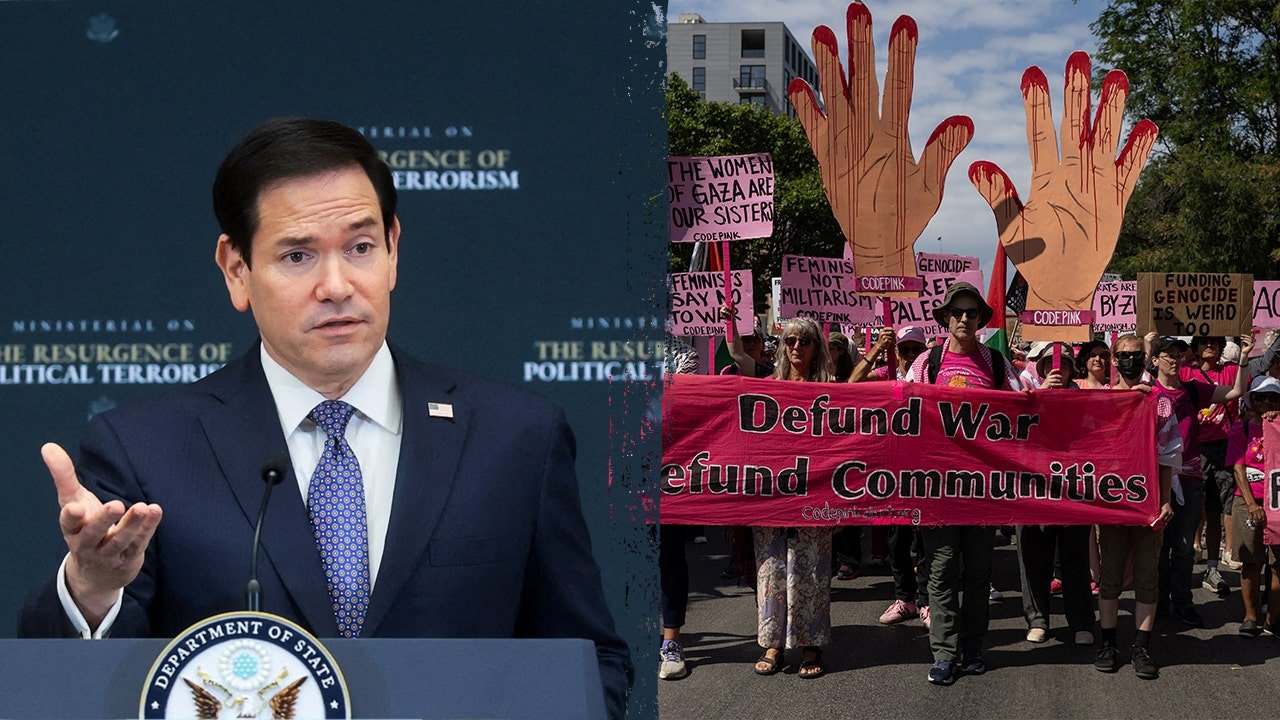
The report focuses particular attention on six organizations: ICAP, the National Network on Cuba, Code Pink, the People’s Forum, the Democratic Socialists of America and the National Lawyers Guild. (Peter Gerber for Fox News Digital)

The rapid-response plan calls for demonstrations and establishes a timeline for activating supporters nationwide. If U.S. military action against Cuba begins before 3 p.m. Eastern time, demonstrations would start at 6 p.m. local time that day. If it begins later, activists would mobilize at 6 p.m. the following day.

Organizers are instructed to gather at federal buildings, courthouses and post offices; military bases and recruiting offices; or ICE detention centers and field offices. The plan also lists sports arenas during high-profile events as optional locations.

The State Department’s focus on the plan comes amid escalating U.S. pressure on Havana and discussion of possible military intervention or regime change. Trump has floated a “friendly takeover” of Cuba and, when asked in May about intervening, said “it looks like I’ll be the one that does it.” Secretary of State Marco Rubio has said the administration prefers diplomacy while leaving military action on the table.

FBI ARRESTS PROTESTER WHO THREATENED TO KILL ICE OFFICER’S FAMILY AT NJ DETENTION CENTER PROTEST, BLANCHE SAYS

The plan says demonstrations at immigration facilities would “connect Cuba solidarity to anti-ICE/immigrant defense work happening nationwide.”

It also directs activists to a Black Alliance for Peace database that the State Department report says maps 1,335 U.S. military and law-enforcement locations across the Western Hemisphere. The group describes the map as a basis for local organizing that can help activists “strategize how and where to organize and agitate.”

The National Network on Cuba openly promotes the plan on its website as part of its “No War on Cuba” campaign, alongside calls for rallies, banner drops, caravans, teach-ins and other demonstrations.

INSIDE CUBA’S FOREIGN INFLUENCE CAMPAIGN: FROM THE ’60S VENCEREMOS BRIGADE TO A CALIFORNIA UNION HALL

The State Department report portrays the plan as a modern example of Cuba’s broader effort to cultivate and mobilize sympathetic organizations inside the United States.

The National Network on Cuba represents more than 60 organizations and works closely with the Cuban Institute of Friendship with the Peoples. ICAP is led by Fernando González Llort, a former member of Cuba’s Wasp spy network, a Cuban intelligence ring that infiltrated exile organizations and gathered information about U.S. military facilities in South Florida during the 1990s, who served 15 years in a U.S. prison before returning to the island.

The report describes ICAP as the central hub of Cuba’s international influence operation, claiming it coordinates more than 2,000 solidarity organizations across more than 150 countries.

The Cuban embassy in Washington could not immediately be reached for comment.

The report focuses particular attention on six organizations spanning Cuban government outreach and American left-wing activism. ICAP is a Cuban government entity, while the National Network on Cuba is a U.S.-based coalition of more than 60 organizations advocating closer relations with Havana.

The other groups are U.S.-based: Code Pink is a left-wing anti-war organization; the People’s Forum is a New York-based activist and political education center; the Democratic Socialists of America is a socialist political organization; and the National Lawyers Guild is a progressive legal association.

Code Pink, the Democratic Socialists of America and the National Lawyers Guild’s Cuba Committee are listed as members of the National Network on Cuba, alongside the Communist Party USA and dozens of smaller organizations.

The extent of each organization’s involvement in the rapid-response plan is unclear. The report argues that their overlapping relationships, delegations and campaigns give Cuba access to a broad American activist infrastructure.

The report says the Democratic Socialists of America has sent multiple delegations to Cuba, including a 2023 trip during which members met privately with Cuban President Miguel Díaz-Canel and sought to establish formal communication with Cuban ministries. It notes, however, that the Democratic Socialists of America was not created or controlled by Cuban intelligence, describing its support for Havana as primarily ideological.

cuba-city

People walk on the street during a blackout in Havana, July 6, 2026. (Ramon Espinosa/AP)

The People’s Forum, meanwhile, is described as a major organizing hub connecting Cuba advocacy with anti-ICE and pro-Palestinian activism. The report says the organization has served as fiscal sponsor for the Venceremos Brigade, which has transported American activists to Cuba for decades, and has helped organize delegations that met with senior Cuban officials.

Code Pink and the National Lawyers Guild also have participated in Cuba delegations and campaigns opposing the U.S. embargo, according to the report. The National Lawyers Guild adopted a resolution in 2026 pledging to work with the National Network on Cuba and the broader Cuba solidarity movement.

The report does not announce sanctions or legal action against the U.S.-based organizations, and much of its underlying evidence comes from public records, organizational materials and previous reporting. Its central conclusion is that Cuba treats traditional espionage, political advocacy and ideological influence as parts of a single long-term campaign against the United States.

The administration has sharply expanded its pressure campaign in 2026: Trump signed an executive order in January allowing tariffs on imports from countries that supply oil to Cuba and followed in May with sanctions targeting foreign entities operating in or supporting key sectors of the Cuban economy, in addition to the long-standing U.S. trade embargo.

CLICK HERE TO DOWNLOAD THE FOX NEWS APP

Code Pink has separately come under federal scrutiny through an investigation into the financial network of Neville Roy Singham, the husband of Code Pink co-founder Jodie Evans and a major benefactor of the group. A federal grand jury in Manhattan is examining potential foreign-agent and tax violations involving Singham’s network.

Code Pink has not been publicly identified as a target of the investigation, and no charges have been filed.

The Treasury Department also has sought information from Code Pink co-founder Medea Benjamin about a March aid convoy to Cuba as officials examine potential sanctions violations. Code Pink has denied wrongdoing and said the delegation delivered humanitarian supplies amid worsening shortages on the island.

Fox News Digital reached out to the Cuban embassy in Washington, the National Network on Cuba, Code Pink, the Democratic Socialists of America and the National Lawyers Guild for comment.

Mais Notícias

Home Page – Início

Source link
More: The Global Track
Corinthia Mes

Golden State Valkyries host Phoenix Mercury in Commissioner’s Cup action. Here’s how to watch.

Golden State Valkyries host Phoenix Mercury in Commissioner's Cup action. Here's how to watch.


The Golden State Valkyries return to San Francisco’s Chase Center Tuesday night looking to build momentum in Commissioner’s Cup play as they host the Phoenix Mercury in another key Western Conference matchup.

Golden State enters the game after an encouraging start to its second season and will look to defend home court against a Mercury team it defeated 95-79 in the home opener on May 10. That victory showcased the Valkyries’ balanced attack and physical defense, two traits that have quickly become trademarks under head coach Natalie Nakase.

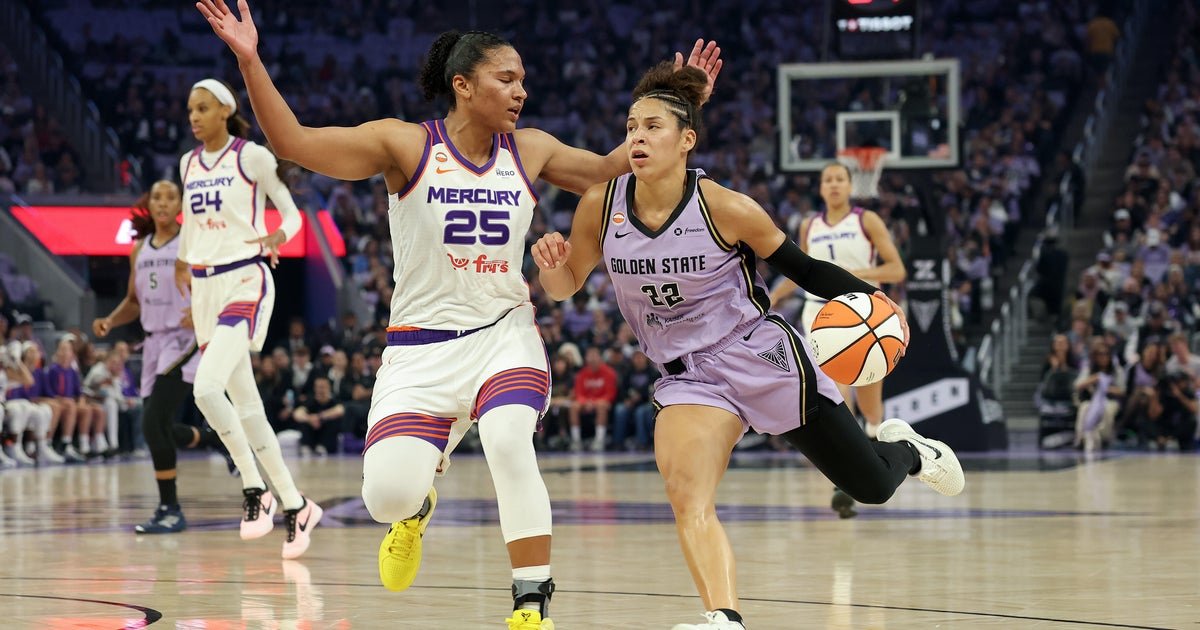
Veronica Burton #22 of the Golden State Valkyries is guarded by Alyssa Thomas #25 of the Phoenix Mercury at Chase Center on May 10, 2026 in San Francisco, California. 

Ezra Shaw / Getty Images


The Mercury, meanwhile, bring a veteran roster led by stars Alyssa Thomas and Kahleah Copper and will be looking to even the season series after dropping the first meeting in San Francisco.

For the Valkyries, continued contributions from Veronica Burton and Janelle Salaün have helped fuel the team’s early success, while Chase Center, affectionately known by fans as “Ballhalla,” has once again become one of the league’s toughest places to play.

Tuesday night’s contest also marks another Commissioner’s Cup matchup, adding extra significance as teams compete for both regular-season wins and Cup standings.

How to watch the Phoenix Mercury vs. Golden State Valkyries

What: Phoenix Mercury vs. Golden State Valkyries

Date: Tuesday, June 9, 2026

Time: Pregame show 6:30 p.m., tip-off 7 p.m. PDT

Location: Chase Center, San Francisco

On TV: KPIX in the Bay Area, KOVR in Sacramento

Online: At CBS Sports cbssports.com/watch/wnba/

On Radio: 95.7 The Game, Audacy App

Source link
More: The Global Track

Corinthia Mes

State Falls Short In Super Regional Slugfest

Georgia logo

ATHENS, Ga. – No. 17 Mississippi State’s offense gave itself every chance Saturday morning at Foley Field.

But a back-and-forth slugfest tilted the wrong way late.

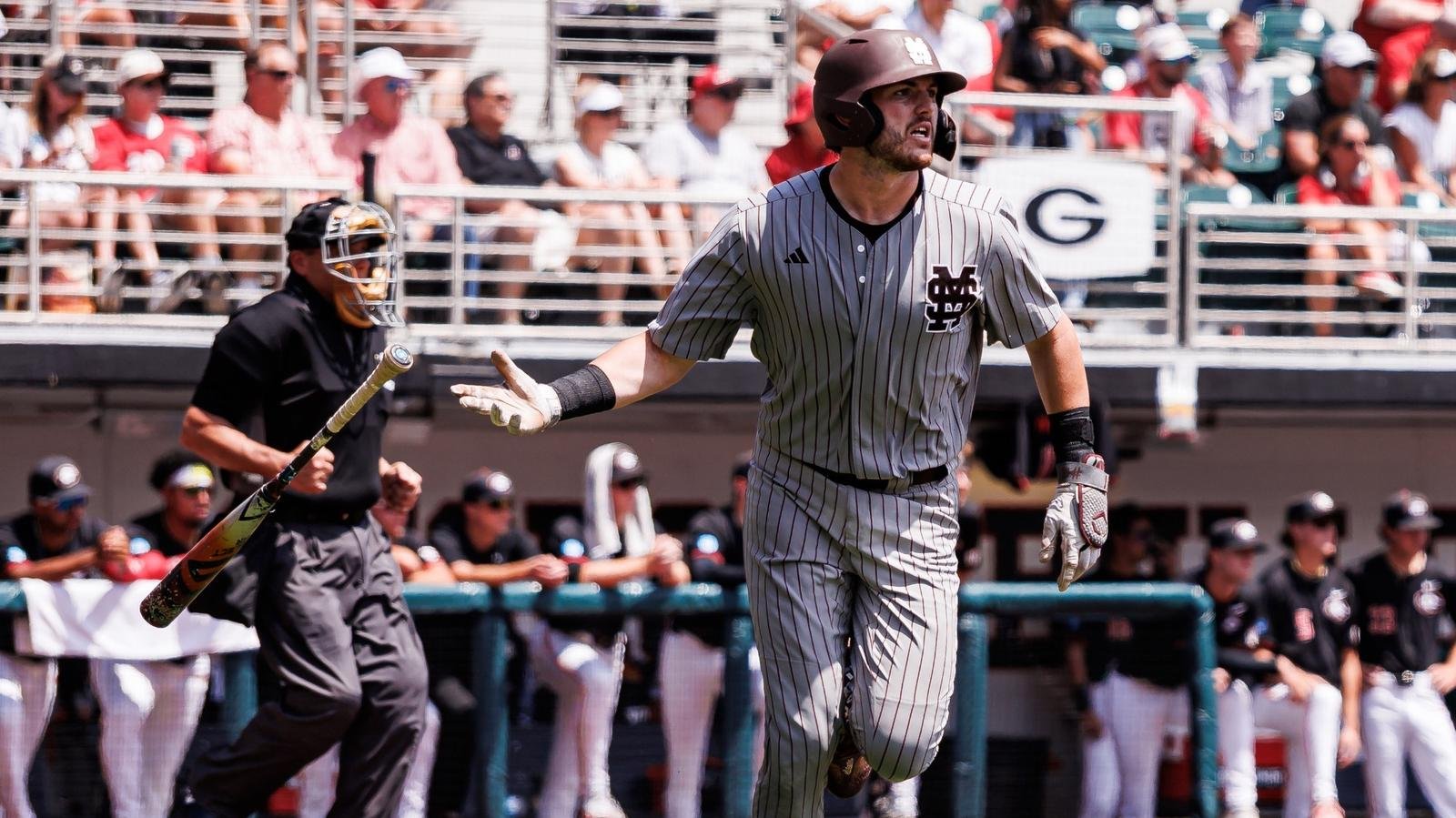
Mississippi State hit six home runs and piled up 15 hits, but No. 3 Georgia used a three-run homer from Mike O’Shaughnessy in the eighth inning to rally past MSU 13-12 in the opening game of the Athens Super Regional.

State (43-18) will try to keep its season alive Sunday at 11 a.m. CT on ESPN. Sophomore right-hander Ryan McPherson (4-1, 2.81 ERA) will start for Mississippi State, while UGA will counter with graduate righty Caden Aoki (9-1, 3.86 ERA).

The game featured 25 runs, 31 hits and 11 home runs.

Mississippi State built its early lead with a six-run second inning. Jacob Parker drew a leadoff walk, Vytas Valincius followed with a single and Reed Stallman launched a three-run homer to right field. Kevin Milewski and Bryce Chance later singled before Ace Reese reached on an error that scored two more runs. Parker capped the inning with an RBI single to center to make it 6-0.

Milewski, who went 3-for-4 with two home runs, three RBIs and three runs scored, pushed the lead to 7-0 with a solo shot in the fourth.

UGA (50-12) surged back in the bottom half. Daniel Jackson and Rylan Lujo opened the inning with back-to-back solo homers, Jack Arcamone added a sacrifice fly and Ryan Black delivered a two-run double to trim the lead to 7-5.

Georgia then grabbed its first lead in the fifth. O’Shaughnessy hit a two-run homer, and Kolby Branch followed later in the inning with a two-run double that put UGA ahead 9-7.

MSU did not go quietly.

Milewski and Gehrig Frei hit solo homers early in the sixth to tie the game at 9. After Lujo’s second homer gave Georgia the lead again in the bottom of the inning, Ryder Woodson answered with a solo shot in the seventh to pull State even at 10.

Reese, who finished 3-for-6, gave Mississippi State the lead again with a solo homer to center in the eighth. Parker walked, Vytas Valincius singled and Milewski was hit by a pitch with the bases loaded to stretch the advantage to 12-10.

But Georgia had one more swing left. After Kenny Ishikawa was hit by a pitch and Jackson singled in the eighth, O’Shaughnessy hit his second homer of the game, a three-run shot to right, to put UGA in front 13-12.

Justin Byrd worked around two base runners in the ninth to earn his eighth save. Grant Edwards picked up the win for Georgia, while Dane Burns took the loss for MSU.

Reese, Milewski and Chance each had three hits for Mississippi State. Frei, Reese, Stallman, Woodson and Milewski accounted for State’s six home runs, with Milewski leaving the yard twice.

O’Shaughnessy drove in five runs for Georgia, while Lujo went 3-for-5 with two solo homers and three runs scored.

Visit www.HailState.com for the latest news and information on the baseball program. Fans can also follow the program on social media by searching ‘HailStateBB’ on X, Facebook and Instagram.

Source link
More: The Global Track

Corinthia Mes

‘Destiny 2’ Fans Drown PlayStation’s State Of Play In ‘Destiny 3’ Demands

‘Destiny 2’ Fans Drown PlayStation’s State Of Play In ‘Destiny 3’ Demands

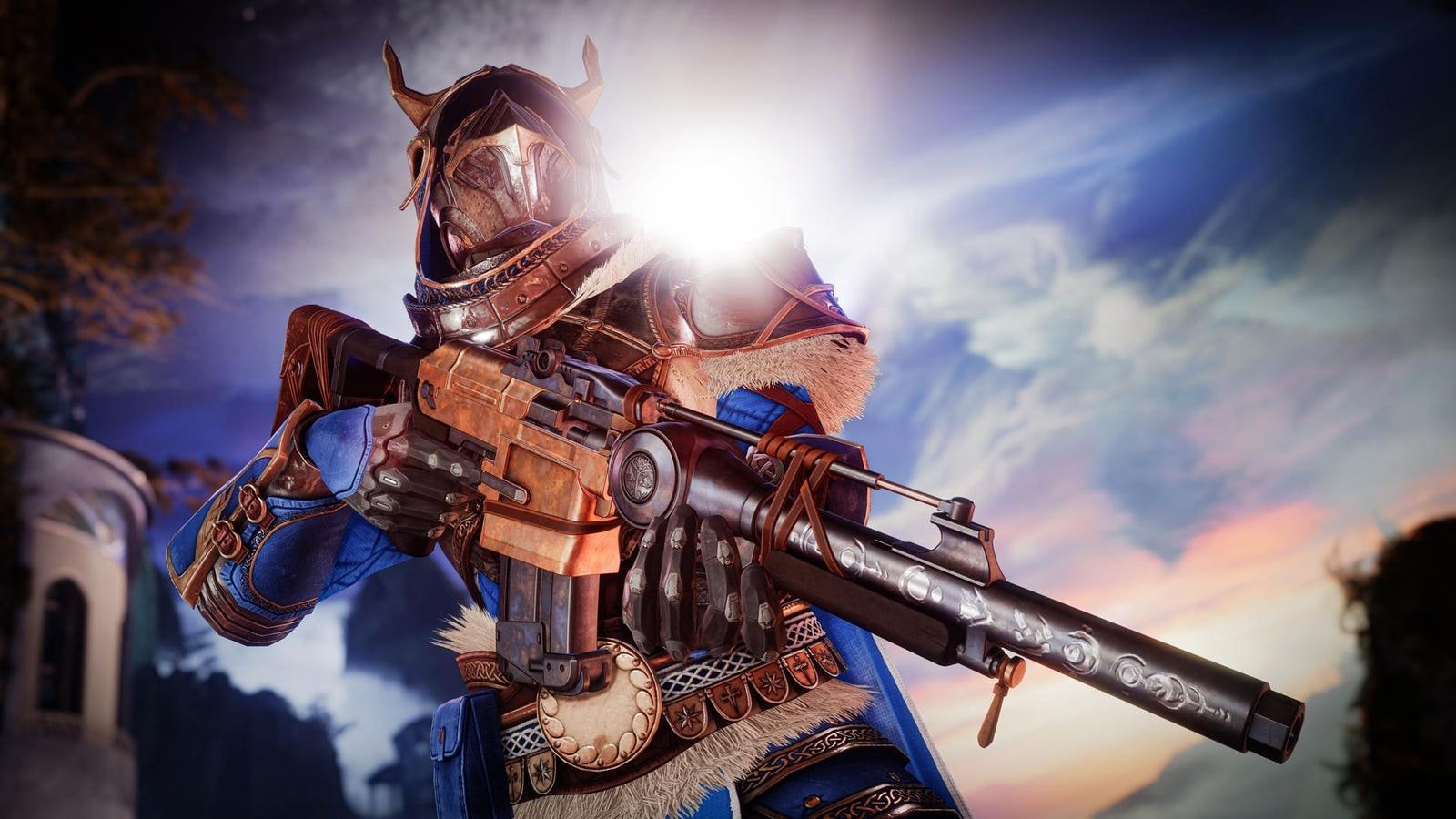
Destiny 2 players continue to find ways to express their anguish and anger about the pending end of development for the game, which will cease after next week’s sizable, exciting June 9 update. Now, they’re trying to blast Sony with a megaphone, and it worked, at least to some extent.

A petition has crossed 340,000 signatures asking Bungie to make Destiny 3 if Destiny 2 is shutting down. In the wake of the June 9 patch reveal, the game’s playercount peaks have nearly tripled, and fans are attempting a huge-scale login event on the 9th itself. But yesterday, fans figured out another way to get Sony’s attention. Perhaps annoyingly, but effectively.

The idea was to spam the mainstream and its offshoots with requests for Destiny 3, be it a written request, hashtag or frequently, a series of emotes made just for this occasion. And it worked. The vast majority of State of Play saw these Destiny 3 requests blasting the comments, and while bans were doled out, it was frequently overwhelming. This happened during the features of blockbusters like Wolverine and God of War Laufey as well.

Source link
See more: https://theglobaltrack.com/
https://corinthiames.com.br/

Buc-ee’s adding travel center in this state. See future openings list

Buc-ee's adding travel center in this state. See future openings list

play

Convenience megastore Buc-ee’s will open a new outpost in northeast Ohio after the company pledged to cover the $15 million infrastructure required to get it up and running.

Buc-ee’s, a chain of convenience stores, gas stations and megamarts known for their large, clean bathrooms and beaver mascot, said its Mansfield, Ohio, location is one of more than a dozen it’s looking to open over the next few years, according to the Mansfield News Journal, part of the USA TODAY Network.

Here’s what to know about the deal, and where Buc-ee’s is headed next.

Buc-ee’s pledges to cover costs as part of deal

Mansfield City Council on June 2 unanimously approved a development plan for a new Buc-ee’s Travel Center in Ohio’s Richland County, which sits roughly halfway between Columbus and Cleveland.

The plan was approved after Buc-ee’s pledged to cover the necessary infrastructure costs, which are expected to run $15 million, according to the Mansfield News Journal.  

“They’re advancing all the money for the infrastructure,” Greg Daniels, outside counsel for the development agreement, told the outlet. “They’re paying it all out of pocket, up front. They will get paid back in turn through (a) sales tax charge.”

The deal is part of a New Community Authority, which Daniels said is common in the Columbus area.

A New Community Authority in Ohio is a public-private partnership that allows cities, counties and developers to share the costs of constructing public infrastructure within a defined district.

Daniels said the sales tax surcharge will be applied to items not including fuel. It will be 2%, with 1.75% going to Buc-ee’s, which is expected to recoup the money in 20 years. The additional 0.25% will be reinvested in infrastructure projects throughout the area.

“We did a lot of work with Buc-ee’s. It was really collaborative,” Daniels said. “I’m very happy with the way it turned out. I think this is a great example of a public-private partnership.”

The project is expected to break ground in the first quarter of 2028, though that is subject to change.

More than a truck stop

Buc-ee’s was founded in 1982 and has since expanded its footprint to more than 50 locations across a dozen states, with the vast majority of outlets in Texas.

The company positions itself as more than your average truck stop or roadside convenience store.

“First and foremost, we are not a truck stop. We like to be known as a family-centered travel center,” Angela Janik, who oversees Buc-ee’s project coordination and development, told the Mansfield City Council. “We’ve essentially turned the industry upside-down. We are more of an all-purpose stop than a convenience stop.”

Buc-ee’s expansion plans through 2031

Mansfield isn’t the only U.S. city getting a new Buc-ee’s.

Crissy Gonzales, Buc-ee’s media coordinator, previously confirmed in an email to USA TODAY the opening dates for the following locations:

  • Goodyear, Arizona: June 22
  • San Marcos, Texas: July 27
  • Benton, Arkansas: Aug. 17

She added that a location in Murfreesboro, Tennessee, is projected to open Nov. 16.

The company’s contact page has several more locations opening through 2031.

2027

  • Ruston, Louisiana
  • Kansas City, Kansas
  • Gallaway, Tennessee
  • St. Lucie, Florida
  • Boerne, Texas
  • Monroe County, Georgia

2028

  • Mebane, North Carolina
  • Lafayette, Louisiana

2029 and beyond

  • Ocala, Florida
  • West Memphis, Arkansas
  • Oak Grove, Kentucky
  • Hardeeville, South Carolina (2031)

Contributing: James Powel, USA TODAY

Drew Pittock covers national trending news for USA TODAY. He can be reached at DPittock@usatodayco.com.

Source link
More: https://theglobaltrack.com/
https://corinthiames.com.br/

Consumers Energy seeking $456M electric rate hike from state regulators

Consumers Energy seeking $456M electric rate hike from state regulators

Less than three months after state regulators approved a $276.6 million electric rate hike for Consumers Energy, the utility is requesting another $456 million increase.

Since 2020, the Michigan Public Service Commission (MPSC) has approved nearly $800 million in rate hikes for Consumers Energy, which provides electricity to roughly 1.9 million customers and natural gas to 1.8 million customers throughout the state.

In addition to the 9.8% increase in residential electric rates sought by the utility, Consumers is seeking an additional 12-month surcharge of $25 million, an additional $52 million over three years for storm restoration expenses, and the continuation and expansion of the Investment Recovery Mechanism approved in its last rate case.

“The Company’s goal is fewer and shorter power outages for customers,” the filing by Consumers Energy stated. “… Without these investments, the desired improvements in reliability cannot occur.”

Michigan Attorney General Dana Nessel said Tuesday that her office plans to intervene, adding that the utility’s rate hike request is loaded with “completely unsupported, inflated costs.”

“Consumers Energy and DTE keep demanding more and more money, the MPSC continues to reward their incessant demands, and the cycle of constant, growing rate hikes are pushing Michigan families and businesses to the brink,” Nessel said in a news release. “Michiganders are facing an affordability crisis, and our utility companies are recording record profits.”

Other rate hike cases open before the MPSC include Consumers Energy’s natural gas rate hike request, DTE’s natural gas rate hike request and electric rate hike request, SEMCO Energy Gas Company’s natural gas rate hike request, and Upper Peninsula Power Company’s electric rate hike request.

Copyright 2026 by WDIV ClickOnDetroit – All rights reserved.

Source link
More: https://theglobaltrack.com/
https://corinthiames.com.br/

Townfall ESRB Rating Surfaces Ahead of State of Play

Townfall ESRB Rating Surfaces Ahead of State of Play

Officially revealed four months ago, Konami’s Silent Hill: Townfall seems to be closer to release than what we initially thought.

Today, the horror game’s ESRB (Entertainment Software Ratings Board) rating has surfaced, which usually happens when a game’s near release; suggesting Townfall’s release date is about to be revealed soon.

And where could it possibly be announced? Well, Sony’s State of Play is set to air later today, and given the franchise’s history, it wouldn’t be out of place to see its release date announced at Sony’s event.

Silent Hill: Townfall Release Date Should Be Announced Very Soon

As expected, the game is rated “M” for mature due to blood, violence and strong language used. The rating summary reads, “SILENT HILL: Townfall is rated M for Mature 17+ by the ESRB with Blood, Strong Language, and Violence. This is a survival-horror game in which players attempt to escape from a fictional island town in Scotland. From a first-person perspective, players explore locations, solve puzzles, and use various weapons (e.g., pistols, shotguns, axes) to defend against hostile creatures. Mutated creatures sometimes appear out of nowhere, lunging at players’ character (i.e, jumpscares). Combat is highlighted by realistic gunfire and large blood-splatter effects, which can stain the surrounding area. Cutscenes include additional instances of violence and blood: a close-up depiction of a character stabbing a body; a man being eaten by a monster. The word “f**k” is heard in the game.”

While Konami hasn’t hinted at or said anything, Sony has a big State of Play set to air later today at 2 pm PT/5 pm ET/6 am JST/5 am HKT. Odds are, it’ll be part of the reveal there, or if not, it might make an appearance at the Summer Game Fest event later this week.

Horror fans, brace yourselves, one way or another, it seems we’ll be hearing about the new Silent Hill game sometime this week.

Another horror game announcement reportedly set to happen this week is Bloober Team’s next project, which is said to be unveiled at Summer Game Fest.

Silent Hill: Townfall has no release date yet, but it is in development by Screen Burn for Konami, and is confirmed for release on the PS5, Xbox Series X|S and PC.

Stay connected to MP1st and the latest news by following us on Bluesky, X, Facebook, TikTok, YouTube, and Google News.

Source link
See more: https://theglobaltrack.com/
https://corinthiames.com.br/

State of Play | Horário, onde assistir, jogos e tudo sobre o evento

State of Play | Horário, onde assistir, jogos e tudo sobre o evento

State of Play

Créditos da imagem:
Reprodução

A Sony vai ter a sua clássica transmissão do State of Play durante o Summer Game Fest nesta terça-feira (02), com um destaque para a chegada de Marvel’s Wolverine, que chega em 15 de setembro de 2026.

Além do jogo, a Sony prometeu mais de uma hora de anúncios, atualizações e trailer de produções que estão sendo desenvolvidas para o PlayStation 5. Até o momento, não existe uma confirmação sobre quais nomes devem aparecer. 

Vale lembrar que o State of Play de junho do ano passado trouxe novidades como Marvel Tokon: Fighting Souls, o remake de Final Fantasy Tactics e o rosto do James Bond de 007: First Light.

Que horas começa o State of Play?

O State of Play começa a partir das 18 horas no horário de Brasília. 

Onde assistir ao State of Play?

A transmissão será feita em inglês, pelas redes oficiais da PlayStation no YouTube e na Twitch. O Omelete fará transmissão ao vivo com comentários em português do Brasil no canal do YouTube e na Samsung TV Plus.

Quais jogos devem aparecer?

Até o momento, não temos confirmações oficiais de quais jogos devem aparecer além de Marvel’s Wolverine. Contudo, alguns nomes como Marvel Tokon: Fighting Souls, Final Fantasy VII Remake Parte 3, Marathon e quem sabe até mesmo GTA 6 não acabe aparecendo também no evento, graças a parceria com a Sony? Tudo é possível. 


Fonte do Artigo
See more: https://theglobaltrack.com/
https://corinthiames.com.br/

Where Affordable Care Act insurance coverage has dropped most in WA • Washington State Standard

Where Affordable Care Act insurance coverage has dropped most in WA • Washington State Standard

Washington’s rural counties saw the largest drops in insurance coverage under the Affordable Care Act after the Republican-controlled Congress failed to extend subsidies that helped consumers afford the plans.

About 250,000 Washingtonians are enrolled this year through the Washington Health Benefit Exchange, down roughly 36,500 from 2025. That amounts to a nearly 13% reduction, the biggest falloff since the marketplace launched in 2013.

The decline isn’t as steep as had been feared. 

State officials estimated last year that as many as 80,000 people could forgo coverage with Congress not extending tax credits for these policies. The issue was at the heart of last fall’s lengthy federal government shutdown as congressional Democrats wanted to see the subsidies extended while Republicans refused.

Premiums rose an average of 21%, due in part to the loss of the enhanced tax credits, which started during the COVID pandemic. The increase was in line with similar hikes nationwide. But losing the subsidies meant even steeper price hikes for some customers.

Those most likely to drop their coverage were young and lower-income.

This coverage is meant for people not covered through their work or government programs like Medicaid or Medicare. Many of those no longer covered could’ve found insurance elsewhere, like joining a family member’s plan or getting employer-sponsored coverage.

“What we expect is that a majority of these folks are now uninsured, and that what we’re going to see is a pretty steep increase from the historically low uninsured rates that we’ve had,” said Laura Kate Zaichkin, director of market competition and affordability at Washington’s exchange.

In February, state officials reported a 19,000-person drop in coverage through Washington’s online marketplace, but more customers fell off as they faced their initial monthly payments with high premiums. 

Future adjustments to marketplace plans still to come have left state officials expecting to see a 30% drop in enrollment over the next few years compared to 2025.

Where coverage losses were sharpest

Enrollment increased nowhere in the state, but some areas have been hit harder than others. 

Rural counties saw some of the biggest drops in coverage between March 2025 and this March. Over 1,100 Yakima County residents went without insurance via Washington Healthplanfinder, amounting to a nearly 18% fall. 

Garfield, San Juan, Franklin, Pacific, Wahkiakum and Asotin counties all saw drops above 20%. But some of those are so small that a few dozen people no longer covered could result in a major percentage decrease.

Meanwhile, residents of rural areas are more likely to rely on Healthplanfinder for their coverage, said Emily Brice, co-executive director at Northwest Health Law Advocates.

“The real challenge there is that folks in rural areas are hit by this double whammy,” Brice said. “They have the soaring prices on one end and then access challenges on the other end, because providers are increasingly less available, more consolidated in rural areas.”

Rural hospitals, also, are expected to be particularly hard hit by the federal cuts to Medicaid coming over the next couple years, though a major infusion of federal dollars to rural healthcare is meant to offset some of that.  And fewer patients will be able to afford to get care from these hospitals, Brice said.

Bigger counties like King, Pierce, Clark and Whatcom saw drops between 9% and 12%. Though King County makes up roughly one-third of the state’s total decrease in enrollment.

Also on the bigger side, Snohomish and Spokane counties saw above-average dips in enrollment, both around 15%. Those counties are larger and the number of people losing coverage totaled 4,407 and 2,789, respectively.

As for congressional districts, the area represented by U.S. Rep. Adam Smith, D-Bellevue, saw nearly a quarter of its enrollees drop coverage so far this year. The roster in Rep. Marilyn Strickland’s district in Pierce and Thurston counties fell 16%. 

The central and eastern Washington districts represented by Washington’s two Republican congressmen, Dan Newhouse and Michael Baumgartner, saw decreases of 11% and 14%, respectively. 

A change included in Republicans’ “big, beautiful bill” also hurt enrollment. The law eliminated all federal tax credits for lawfully present immigrants whose income is under 100% of the federal poverty line.

“We’re seeing really significant drops from that population,” Zaichkin said. 

Asked about the decline in his district, Baumgartner said “healthcare is extremely important,” but otherwise focused on the cuts to Medicaid he voted for last summer and criticized the state for extending Medicaid coverage to some noncitizens.

The state’s own premium assistance, known as Cascade Care Savings, helped avert some of the more dire notions of the drops in coverage.

This year, 65% of enrollees are still accessing some form of federal subsidy to help pay for their health plan on the marketplace, compared to 75% last year. Some of the biggest drops in this aid came in places like Chelan, Island and Jefferson counties.

Obstacles ahead

Premiums are expected to rise further next year, with insurers requesting an average 22.4% rate increase for individual health insurance. The state Office of the Insurance Commissioner will review the proposals to see if they’re justified before potentially approving them around September.

A slew of changes in the coming years are expected to further curb enrollment.

In 2027, lawfully present noncitizens will lose eligibility for federal premium tax credits, with some exceptions. Medicaid access for refugees and asylees will be cut this year. Nationwide, the Congressional Budget Office has estimated the loss of the subsidies would kick 900,000 people off coverage by 2034.

People losing access to Medicaid due to new work requirements Congress approved last year won’t be able to get premium tax credits to switch over to marketplace coverage.

“That’s going to be a major affordability and access barrier,” Zaichkin said.

Open enrollment will be reduced to nine weeks. This past year, it lasted from Nov. 1 to Jan. 15.

And in 2028, returning customers can’t automatically renew their coverage in plans that are the same or similar each year. Other changes will require more paperwork to sign up in the first place. 

“Nobody thinks that signing up for health coverage is easy now,” Brice said. “Who asked for this? Nobody said ‘I want my health insurance coverage process to be more complicated and annoying.’”

Source link
More: https://theglobaltrack.com/
https://corinthiames.com.br/

Alabama baseball vs Oklahoma State score, live updates from NCAA regional

Alabama baseball vs Oklahoma State score, live updates from NCAA regional

One more win for Alabama baseball can punch the Crimson Tide‘s first ticket to Super Regionals since 2023.

The Crimson Tide will face 2-seed Oklahoma State on Sunday, May 31 in hopes of clinching the Tuscaloosa region championship.

Alabama, the No. 7 overall seed in the NCAA Tournament, is 2-0 on the weekend with victories over 4-seed Alabama State and 3-seed USC Upstate. Having stuck with its starting rotation, the Crimson Tide is due to start right-hander Myles Upchurch, who has gone 8-3 at Alabama (39-19) as a freshman standout.

For live updates and highlights from the game, follow along with The Tuscaloosa News.

Live score updates, highlights for Alabama baseball vs Oklahoma State

Fans in The Joe roared after freshman Myles Upchurch ended the first inning of his postseason debut with a strikeout. The Crimson Tide defense supported the right-hander by fielding the first two outs of the half.

Check back here for the most up-to-date score!

Start time for Alabama-Oklahoma State in Tuscaloosa Regional

Date: Sunday, May 31

Start time: 7 p.m. CT

The first pitch of the regional title game on Sunday, May 31 is set to be thrown at 7 p.m. CT, barring weather delays.

TV channel, streaming for Alabama baseball in NCAA Tournament

TV channel: TBD

Streaming: ESPN+

The Alabama-Oklahoma State game will be streamed via ESPN+. TV information has yet to be determined.

play

Rob Vaughn recaps Alabama baseball 2026 regular season | VIDEO

Alabama baseball coach Rob Vaughn recapped the 2026 regular season for the Crimson Tide, which finished 37-18 overall and 18-12 in SEC play.

Emilee Smarr covers Alabama basketball and Crimson Tide athletics for The Tuscaloosa News. She can be reached via email at esmarr@usatodayco.com.

Source link
More: https://theglobaltrack.com/
https://corinthiames.com.br/

Texas Tech made Mississippi State pay for hitting Mia Williams in WCWS

Texas Tech made Mississippi State pay for hitting Mia Williams in WCWS

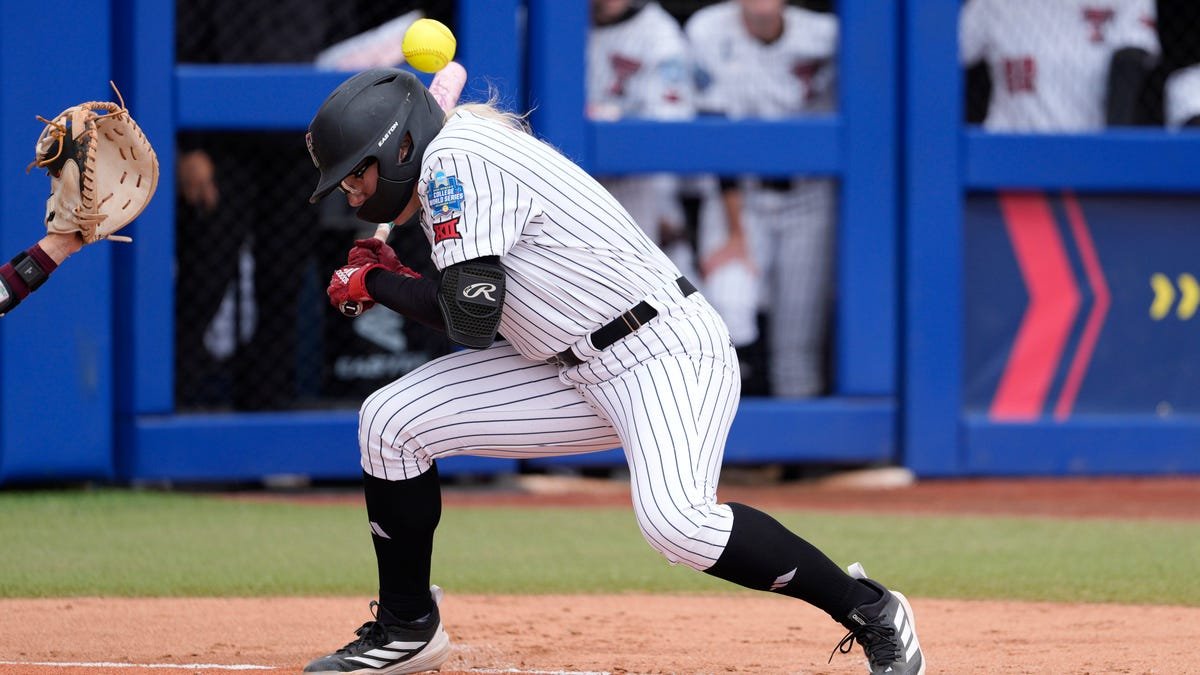
OKLAHOMA CITY — Hitting a batter with the first pitch of a game is not ideal for any pitcher, especially when that batter has already been hit five times in the previous three games, sparking a boost of energy for her team.

But that’s exactly what Mississippi State softball did in its first Women’s College World Series game in program history against Texas Tech on May 28 at Devon Park.

Alyssa Faircloth hit Mia Williams with her first pitch in the bottom of the first inning, putting her on base for Jackie Lis’ two-run home run the next at-bat.

The Bulldogs (43-20) lost 8-0 to the Red Raiders (58-7) in five innings and will play No. 2 seed Texas (47-12) next on May 29 (6 p.m. CT, ESPN2) in an elimination game.

“When your teammate gets hit you take that personally,” Lis said. “And if we didn’t learn anything from last weekend, when Mia Williams gets hit, you take it personally and you step up for your team in those moments.”

In the super regionals, Williams was hit five times by Florida, her former school. Although those moments didn’t directly result in runs for the Red Raiders in Gainesville, they did in Oklahoma City.

“They know it wasn’t on purpose. We know it wasn’t on purpose,” MSU coach Samantha Ricketts said of Williams getting hit. “It’s a competitive, pressure-filled moment. Either side is going to use anything they can to really fire up a dugout. … I think emotion in this game is huge.”

As a first-time WCWS team, MSU’s players, including Faircloth, entered the game with nerves, and it didn’t help that the Red Raiders got off to such a big start.

“I think you could see it from Alyssa little bit, particularly the first inning,” Ricketts said. “… Against that lineup, you have to be on. There’s no letup. You can’t let up in the nine hole, anywhere in the bottom of that lineup.”

MSU again saw how hitting Williams became a catalyst for Texas Tech’s offense in the fifth inning.

Pitcher Peja Goold walked Williams to lead off the inning. This time instead of hitting her at the plate, MSU hit her on the base path. Catcher Des Rivera tried to pick Williams off at first and accidentally hit her in the head with the ball. Because the ball bounced into the camera well behind the base, the umpire awarded Williams two bases, moving her to third.

Lis again brought Williams home, singling for the RBI. The Red Raiders didn’t stop there. Later in the inning, Kaitlyn Terry singled to score Lis, then, Mihyia Davis singled to score Taylor Pannell. Terry also scored on the at-bat due to a throwing error, ending the game.

Tia Reid covers Jackson State sports for the Clarion Ledger. Email her at treid@usatodayco.com and follow her on X @tiareid65.

Source link
See more: https://theglobaltrack.com/
https://corinthiames.com.br/