Newsletter Subscribe
Enter your email address below and subscribe to our newsletter
Enter your email address below and subscribe to our newsletter


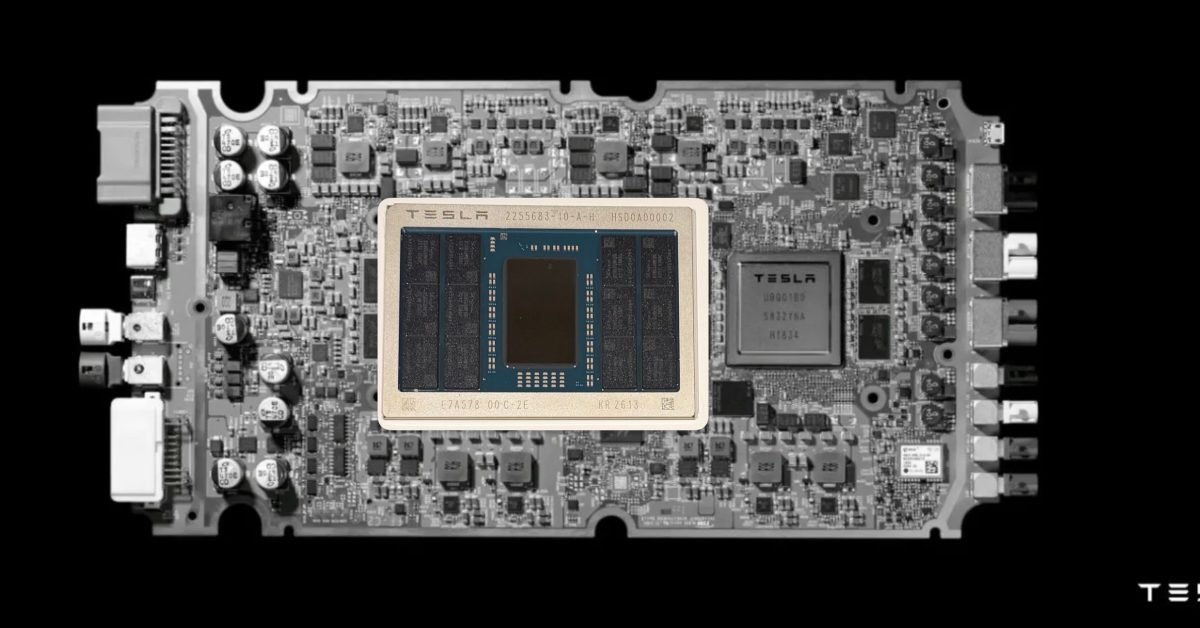
Tesla has taped out its next-generation AI5 self-driving chip, CEO Elon Musk said overnight, a key milestone that sends the final design to the foundry for fabrication.
The tape-out comes nearly two years after Tesla originally promised AI5 would be in vehicles, and it still leaves volume production more than a year away.
In a post on X at 3:21 AM today, Musk wrote: “Congrats to the @Tesla_AI chip design team on taping out AI5! AI6, Dojo3 & other exciting chips in work.”
He shared this picture of the chip:
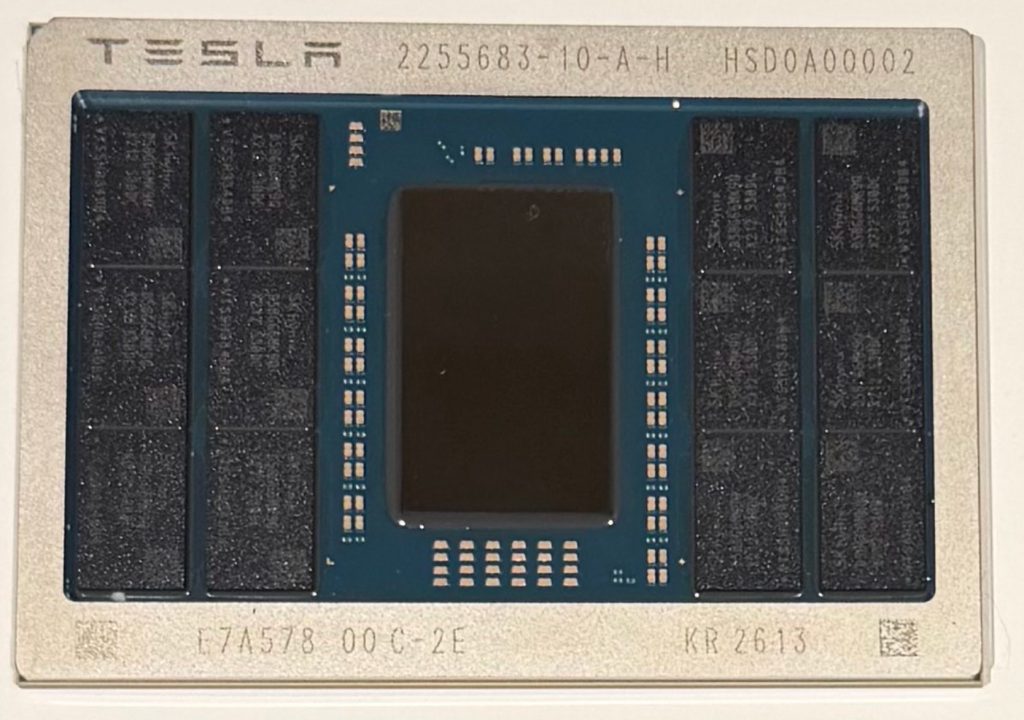
A “tape-out” is the point at which a chip’s design is locked and sent to a semiconductor foundry to begin fabrication. It is a meaningful milestone — but it is not the finish line. After tape-out, the chip still has to be manufactured, tested in silicon, validated, and ramped to volume production. For an automotive-grade AI accelerator, that process typically takes 12 to 18 months.
Tesla is reportedly using TSMC for AI5 production, while Samsung’s 2nm line is tied to the follow-on AI6 chip. We reported last month that AI6 has already slipped roughly six months because of Samsung 2nm yield issues, pushing mass production to Q4 2027 at the earliest.
Today’s tape-out is worth putting next to Tesla’s own earlier promises on this chip:
Musk has previously described AI5 as up to 10x more powerful than AI4 and floated a 9-month design cycle for subsequent generations — a cadence that, as we’ve noted, is unheard of for a major architectural overhaul in the semiconductor industry.
Tesla’s own “AI4.5” stopgap computer, quietly introduced in 2026 Model Y vehicles late last year, exists precisely because of this delay. The company needed more compute to keep feeding larger FSD neural networks while AI5 slipped.
The practical implication of today’s milestone is straightforward: AI5 is real and moving, but it will not be in a meaningful number of vehicles this year.
Tesla has already confirmed the Cybercab — scheduled for production in Q2 2026 — will launch on AI4, the same hardware currently sold in Model Y, Model 3, Model S, Model X, and Cybertruck. Tesla has said it needs “several hundred thousand completed AI5 boards line side” before it can switch production lines, and that volume isn’t expected until mid-2027.
AI6, Dojo3, and whatever other chips Musk is alluding to remain on paper.
Tesla’s AI hardware progress is, honestly, bittersweet.
On one hand, we want to see Tesla’s self-driving compute get better. FSD is clearly compute-bound on bigger neural nets, and more powerful silicon is part of the path forward. A taped-out AI5 is real progress after years of slipping timelines, and it’s good to see the chip finally heading to the fab.
On the other hand, every new Tesla chip generation carries the same problem: it makes the last one obsolete before Tesla has delivered what it sold on that hardware. Tesla sold millions of cars with HW3 and HW4 on the promise of unsupervised self-driving. HW3, by Musk’s own admission last year, can’t do it. HW4 is running V14, and it still isn’t unsupervised. AI4.5 is already in new Model Ys. Now AI5 is taped out, and AI6 and Dojo3 are coming.
The pattern is hard to miss: Tesla keeps moving the goalpost to the next chip instead of delivering what was promised and sold on the current one. Every tape-out announcement is, in that sense, also a quiet confirmation that a lot of existing customers are not getting the product they paid for on the hardware they own.
That’s the part Musk never congratulates the team for.


FTC: We use income earning auto affiliate links. More.