
Newsletter Subscribe
Enter your email address below and subscribe to our newsletter
Enter your email address below and subscribe to our newsletter


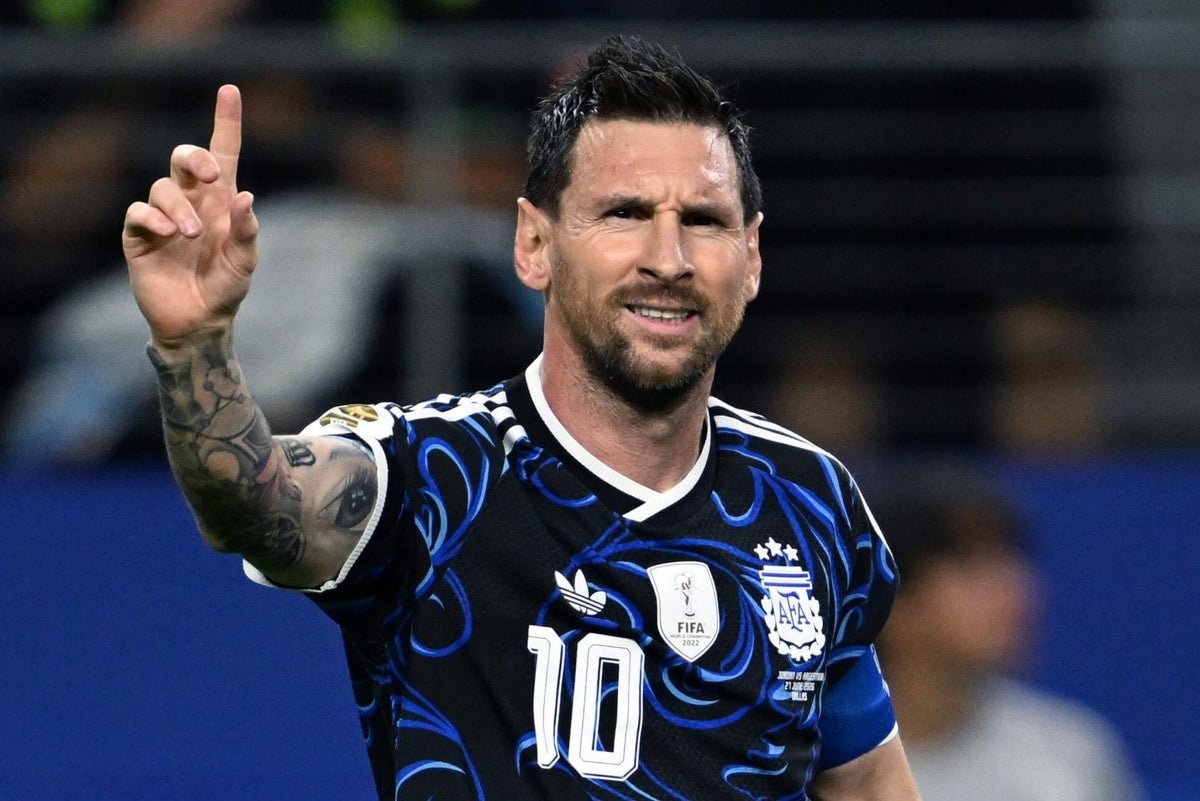
Rarely has a World Cup Golden Boot race felt this stacked with quality.
Usually, the battle to finish as the tournament’s top scorer is a mix of a couple of elite talents and a few surprise packages catching fire at the perfect time. In this tournament, though, the leaderboard has become an exclusive club, reserved for top-end, household-name forwards only.
Argentina’s Lionel Messi and France’s Kylian Mbappe lead the way on six goals apiece, with Norway’s Erling Haaland and England’s Harry Kane one behind, while Brazil’s Vinicius Junior and Mbappe’s team-mate Ousmane Dembele are still in touch on four.
It is a blistering pace, one that has lifted Messi and Mbappe to unprecedented heights. Both have now overtaken Miroslav Klose’s previous World Cup record of 16 goals, with Messi on 19 and Mbappe on 18. Yet there is another, arguably more impressive record now in their crosshairs: France striker Just Fontaine’s 13 goals at the 1958 tournament, still the most by any player at a single World Cup.
It seemed a record destined to remain out of reach. Fontaine belonged to a looser, more free-scoring era of World Cup football, before disciplined defensive blocks, detailed opposition analysis and improved physical conditioning reduced the space available to modern forwards. The last player to even reach double figures at a World Cup was Germany’s Gerd Muller, who scored 10 at Mexico 1970.

But the expansion of the tournament to 48 teams has opened the door for the current crop. There is now an extra knockout round, while the larger field has inevitably widened the gap between the strongest and weakest sides. Goals are flowing at 2.94 per game, the highest rate since Mexico 1970, and the average margin of victory stands at 2.18, the largest since 1974.
Fontaine fanatics will point out he reached his staggering total of 13 goals in just six games, while Messi and company could have two extra matches to overhaul him. But Messi, who plays his round-of-32 tie against Cape Verde on Friday, is matching Fontaine goal for goal. As the chart below shows, his tournament has followed the same game-by-game scoring pattern, with Haaland, Kane and Mbappe only just off the pace.

Remarkable as Fontaine’s strike rate was, he does not hold the record for most goals per game at a single tournament (of those players who have made at least three appearances — let’s not forget Ernst Wilimowski). That honour belongs to Hungary striker Sandor Kocsis, who scored 11 in five matches in 1954. Should they sustain their current levels, Mbappe, Haaland and Messi’s campaigns would all enter the top 15 single-tournament scoring rates in World Cup history, higher than any since 1970.

There is some debate around whether Fontaine’s record should even count in the first place. His final four goals of the tournament were scored in a third-place play-off against West Germany. Third-place play-offs are essentially meaningless games, as two disheartened losing semi-finalists slug it out for a bronze medal that will quickly be forgotten. Some argue that records from such matches should be expunged from the record books, including the quickest goal in World Cup history, scored by Turkey’s Hakan Sukur, after 11 seconds, against South Korea in the 2002 third-place play-off.
In any case, it is unlikely FIFA will discredit the merits of one of their “104 Super Bowls”. Instead, those looking to chase history need to focus on scoring and playing in as many games as possible.
This is where the sheer depth of high-quality forwards gives this tournament a better chance than most. Four players on five or more goals after four rounds of games has not happened since 1938, a tournament that is not strictly comparable because of its use of replays for tied games. It means there are more dominoes to fall before the Golden Boot race is stripped of its elite scorers.
With a tournament-leading scoring rate of two goals per game, and Argentina’s round-of-32 tie still to come, Messi is in pole position to eclipse Fontaine. Using The Athletic’s tournament forecasting probabilities, and remembering that semi-finalists are guaranteed to play one more match, be it a final or third-place play-off, Messi is expected to play 3.8 more games.
Assuming he holds his current goalscoring rate across those expected games, he is projected to finish on 13.7 goals. Mbappe, meanwhile, is forecast to finish on roughly 11, with the other contenders projected lower because they are deemed less likely to reach the latter stages. Forecasts and probabilities are ultimately educated guesses, though; the World Cup has a habit of throwing logic and sense out of the window. Mbappe did score a hat-trick in the 2022 final, after all.
Will any of these superstars break Fontaine’s record? Maybe, Just maybe.
Source link
See more: The Global Track